Every row up to this point followed the same pattern: one consonant, five vowels, or three for ヤ, ユ, ヨ. This last group breaks that shape entirely, exactly the way its hiragana counterpart did. ワ is the lone survivor of what was once a full W-row. ヲ has almost no job left in modern Japanese. And ン is not a consonant riding on a vowel at all, it is the one standalone sound in the whole system, and it is also the character this series has been building toward since the S-row.
ワ (wa)
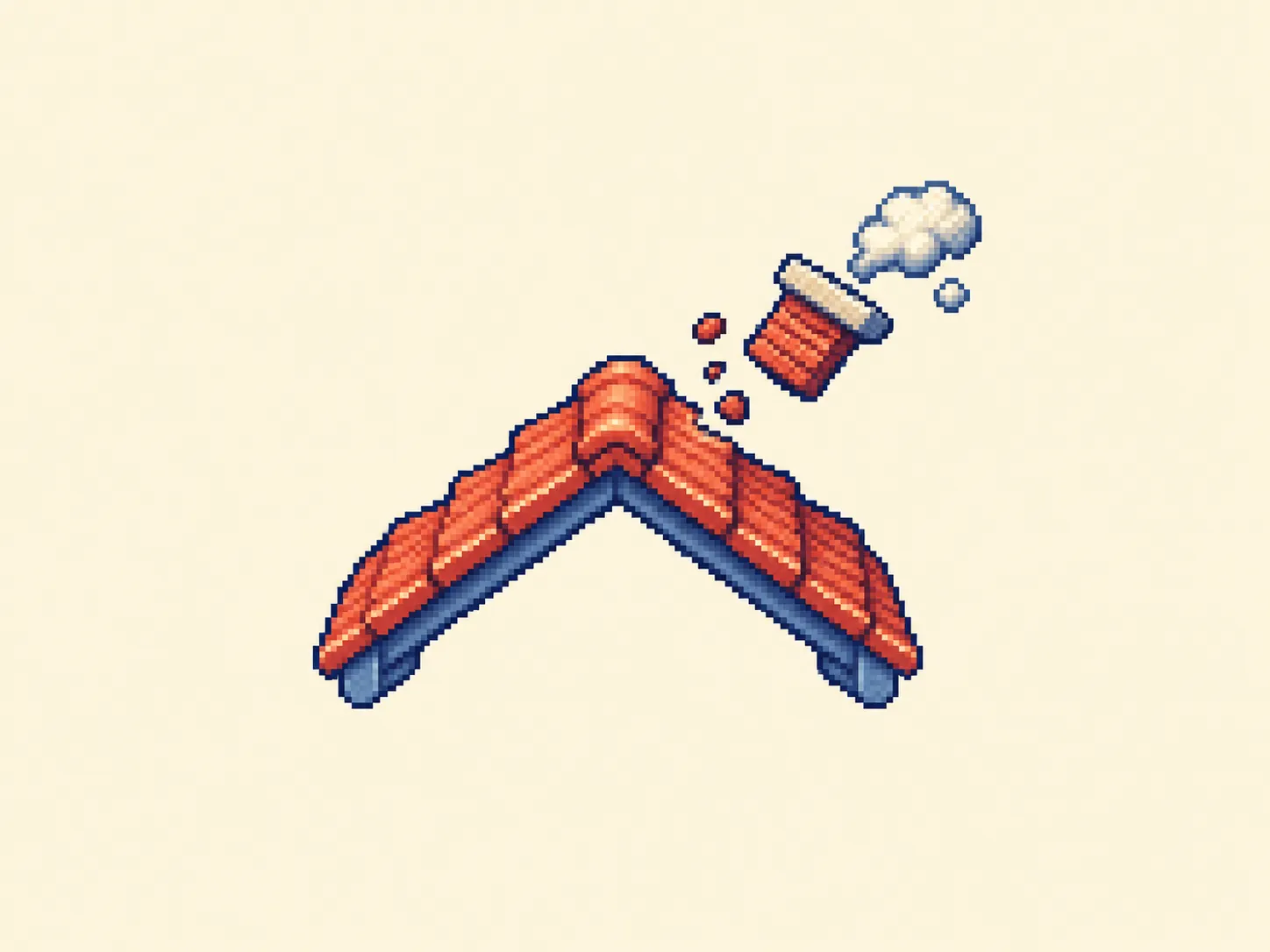
ワ (wa)
ワ is a fragment of 和, a character worth knowing on sight: it means "harmony," and it is also how Japan refers to its own traditions, as in 和食 (washoku, Japanese food) and 和室 (washitsu, a Japanese-style room). The shape is one you already know. Take ウ and knock off the little tick on top: what is left is ワ, a short stroke down the left side and a bar that runs across and turns down the right. Against フ, which is that bent bar alone, ワ has the extra short leg on the left.
Hook: ウ was a roof with a chimney. ワ is the same roof after a gust of wind has blown the chimney off. "Wa!" as it goes.
Stroke path: a short stroke down the left side, then a stroke that starts at the top of it, runs across to the right, and turns down, curving off to the lower left. Two strokes, the same as the bottom two strokes of ウ.
Sound: "w" plus the "ah" from ア. The W-row once also had ヰ (wi) and ヱ (we), but only ワ survived into regular modern use, the same story as hiragana わ.
ヲ (o, written "wo")
ヲ (wo)
ヲ is a fragment of 乎: two horizontal bars, with a long stroke falling from the right end of the top bar to the lower left. Put another way, it is フ with an extra bar across the middle.
Here is the fact that matters more than the shape: in modern Japanese, katakana ヲ is close to a museum piece. Its hiragana twin, を, is a grammar particle, mostly marking the direct object of a sentence, and that job is written in hiragana essentially always, because katakana does not write particles. So ヲ has almost no reason to appear in ordinary text at all. When it does show up, it is usually deliberate: old telegrams, written entirely in katakana with the particles included, used it constantly, some video games and stylized logos use it for flavor, and internet slang occasionally spells オタク (otaku, a devoted hobbyist) as ヲタク for a knowing, exaggerated effect. Learn it for completeness and for recognizing it when it turns up, not because you will write it often.
Stroke path: the top horizontal, then the middle horizontal, then a long stroke starting at the right end of the top bar and sweeping down to the lower left. Three strokes, the most in this trio.
Sound: identical to オ, not literally "wo." The romaji spelling is a historical leftover, the same as hiragana を. Because katakana already had a working オ, and because katakana rarely needs to write a grammatical particle in the first place, ヲ ended up with no real niche of its own. Learning it is closer to learning a piece of trivia than learning a tool you will reach for.
ン (n)

ン (n)
This is the character the whole series has been circling. Back in the S-row you learned the rule for シ, ツ, ソ, and ン: look at the short strokes, then check the direction of the long sweep. ン is the last of the four, and it follows the シ half of the rule exactly. Its short stroke lies flat, and the long stroke sweeps upward, from lower left to upper right. Flat stroke, upward sweep, same as シ. Its closest look-alike, ソ, has its short stroke in the same upper-left spot but standing steep, and sweeps downward instead.
Hook: シ was a sideways smiling face with both eyes open. ン is the same face winking: one eye shut into a flat little line, the grin still sweeping up. "Nn!" it hums, pleased with itself. A closed eye is always flat, which is exactly what separates ン from ソ's steep needle.
Beyond the shape, ン is doing something no other character in the basic set does: it takes a full beat of its own without being a consonant plus a vowel. It is a nasal sound on its own, close to the "n" in "button" cut short, or the "ng" in "song," depending on what follows it. Two rules make it usable:
1. ン never starts a word. It only ever follows another character.
2. ン takes up one full beat of rhythm, exactly like every other character, even though it is a single consonant sound with no vowel attached.
That second rule is why ライオン (raion, lion) is four beats, not three: ra-i-o-n, with the ン landing as its own distinct beat at the end, not folded into the オ before it. It is also why ン can shift its actual sound slightly depending on what comes after it, closer to "m" before certain consonants, closer to "ng" before others, while still being written as the same single character every time. You do not need to track those shifts consciously. Native speakers make them automatically, and your ear will start to pick them up the more real audio you listen to.
Stroke path: a short, fairly flat stroke at the upper left, slanting down to the right, then a longer stroke starting at the bottom left and sweeping up to the right. Two strokes.
Sound: the standalone "n," never combined with a vowel of its own.
Reading real words
Forty-six characters. Every word below uses only characters from across this entire series, plus the ー bar.
| Word | Reading | Meaning |
|---|---|---|
| ワイン | wain | wine |
| レストラン | resutoran | restaurant |
| ワニ | wani | crocodile |
| ライオン | raion | lion |
| サラリーマン | sararīman | salaried office worker |
| ホワイト | howaito | white |
| ミルク | miruku | milk |
| ハワイ | hawai | Hawaii |
サラリーマン is worth reading in full, slowly: サ-ラ-リ-ー-マ-ン. Six written units, six beats, with the ー holding the リ for one of them, spanning the S-row, R-row twice, M-row, and finally ン itself. If you can read that one cleanly, you can read almost anything else in this series's word lists.
Two more the slow way, both ending in the character this whole article is about:
- ライオン. ラ is "ra." イ is "i." オ is "o." ン is "n." ra-i-o-n. Lion, with the standalone ン landing as its own full beat at the very end rather than blending into the オ before it.
- レストラン. レ is "re." ス is "su." ト is "to." ラ is "ra." ン is "n." re-su-to-ra-n. Restaurant, five beats for a three-syllable English word, which is about as much vowel-padding and beat-stretching as you will see happen to a single word in this entire series.
The full 46 characters, done
If you have worked through every article in this series in order, vowels through here, you now know all 46 basic katakana characters, not as a chart memorized by position, but as sounds and shapes you can recognize out of order, under time pressure, mixed with hiragana distractors. That is a meaningfully different skill than reciting a chart from the top, and it is the one that actually transfers to reading real Japanese, menus, product packaging, and the loanwords that make up a surprising share of everyday vocabulary.
Two things are left to complete the full katakana system, mirroring exactly what came next for hiragana: dakuten and handakuten marks that turn カ into ガ or ハ into パ, covered for both scripts in Diacritical Marks Guide, and the contracted sounds built from small ャ, ュ, ョ attached to characters like キ and シ, covered in Contracted Sounds Explained. Both build directly on what you have just finished, and neither should take as long as the main 46 did, especially now that you have been through this exact process once already with hiragana.
What actually got built, row by row
It is worth looking back at what carried this series, because none of it was really about memorizing forty-six pictures. Four running threads did almost all the work: kanji origin (ハ is 八, ニ is 二, テ is the top of 天, and a dozen more), the small number of confusable families that kept recurring (ソ/ン/シ/ツ, ル/レ, ロ/コ), the fact that katakana loanwords insert vowels into English consonant clusters in a completely predictable way, and, underneath all of it, the sounds you already owned from hiragana, waiting for new shapes to attach to. Any one of those four, on its own, would have made the alphabet learnable. Together they made it fast.
Before you call the set fully done, one more pass is worth the time. Across all 46:
- Read a full row at a glance, any row, without narrating shapes to yourself
- Tell every pair in the シ/ツ/ソ/ン family apart on sight, at speed
- Tell ル from レ and ロ from コ without hesitating
- Read all eight practice words above, plus at least a dozen more from earlier articles, out loud, at a normal pace
- Mix hiragana and katakana in one Match round and stay accurate
Where to go from here
Understanding Katakana is worth rereading now that you have actually lived through the whole system rather than just skimmed the overview. If hiragana ever gets fuzzy, Getting Started with Hiragana and its own final characters article cover the same ground for that script. And Hirakata's Study mode has ワ, ヲ, and ン ready to drill on their own before you fold them back into a full run-through of all 46, both scripts, mixed together, which is the real test of everything this series set out to do.