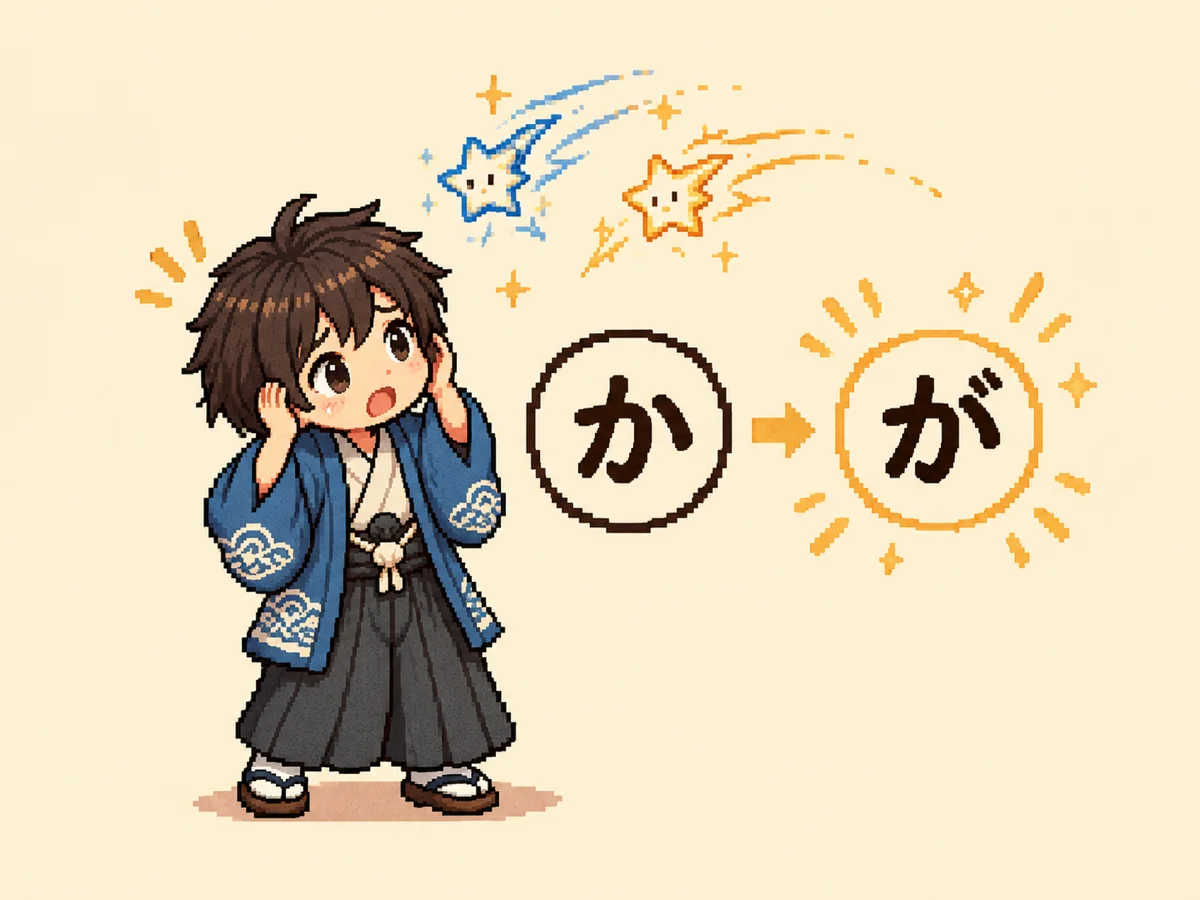
At some point after learning the 46 basic hiragana, I opened a manga page expecting to recognize most of it and instead felt like I was back at zero. Characters I knew had these little marks attached to them — two tiny strokes, or a small circle — and suddenly nothing was readable. My first instinct was that I'd need to memorize another 40-something characters.
That instinct was wrong. And once I understood why it was wrong, dakuten and handakuten became the fastest part of the whole hiragana system to learn.
The marks themselves
There are two of them. Dakuten (濁点) is two small diagonal strokes written to the upper right of a character: ゛. Handakuten (半濁点) is a small circle written in the same position: ゜.
That's it. You're not learning new characters — you're learning what happens when you add one of these two marks to characters you already know.
Dakuten: voicing a consonant
Dakuten turns a voiceless consonant into its voiced equivalent. The simplest way to feel this is to say "ka" and then "ga" out loud. Same mouth position, same vowel — the only difference is that your vocal cords turn on for "g" but stay quiet for "k." Same for s/z and t/d. H to B is the odd one out. It isn't a true voicing pair in modern Japanese, it's left over from a time when the H-row was pronounced closer to P.
Add dakuten to any K-row character and it becomes the G-row. That's a rule, not a list to memorize. But here are the full pairings:
K-row → G-row
- か (ka) → が (ga)
- き (ki) → ぎ (gi)
- く (ku) → ぐ (gu)
- け (ke) → げ (ge)
- こ (ko) → ご (go)
S-row → Z-row
- さ (sa) → ざ (za)
- し (shi) → じ (ji)
- す (su) → ず (zu)
- せ (se) → ぜ (ze)
- そ (so) → ぞ (zo)
T-row → D-row
- た (ta) → だ (da)
- ち (chi) → ぢ (ji)
- つ (tsu) → づ (zu)
- て (te) → で (de)
- と (to) → ど (do)
H-row → B-row
- は (ha) → ば (ba)
- ひ (hi) → び (bi)
- ふ (fu) → ぶ (bu)
- へ (he) → べ (be)
- ほ (ho) → ぼ (bo)
The moment that made this click for me: I noticed that が is literally just か with two marks. I'd been staring at が like it was a foreign symbol, but it was just か wearing a hat. After that I stopped seeing these as new characters entirely and started seeing them as transformations of things I already knew.
Handakuten: the P-row
Handakuten only applies to the H-row and only creates one thing: P-sounds. It doesn't work on any other row.
H-row → P-row
- は (ha) → ぱ (pa)
- ひ (hi) → ぴ (pi)
- ふ (fu) → ぷ (pu)
- へ (he) → ぺ (pe)
- ほ (ho) → ぽ (po)
So the H-row is doing double duty. Add dakuten and you get B. Add handakuten and you get P. ふ alone maps to three sounds depending on its mark: fu, bu, pu.
The special cases worth knowing
The S-row and T-row each produce a pair of characters that sound identical in modern Japanese:
- し + dakuten → じ (ji)
- ち + dakuten → ぢ (ji) — same sound as じ
- す + dakuten → ず (zu)
- つ + dakuten → づ (zu) — same sound as ず
In practice, じ and ず are far more common. You'll run into ぢ and づ occasionally — usually in compound words where the root character is ち or つ — but you don't need to worry about producing them correctly when writing. Just know they exist and what they sound like when you encounter them reading.
Writing them is easy once you know the base character: the ticks or the circle always go on last. The hiragana and katakana stroke order charts show every voiced form, and each row page lets you trace them.
Words you can now read
The reason this matters immediately: a huge portion of common Japanese vocabulary uses these modified characters. You couldn't read most real Japanese before this, even with all 46 base characters. Now you can.
- がっこう — school
- じしょ — dictionary
- でんわ — telephone
- ばんごはん — dinner
- えんぴつ — pencil
- ざっし — magazine
- どうぞ — please (go ahead)
- ぼうし — hat
I'd recommend going row by row rather than trying all four dakuten rows at once. K→G first — it's the cleanest transformation and the easiest to hear. Once that's solid, move to S→Z, then T→D, then H→B, then handakuten. Each one builds on the same logic.
The Review mode in Hirakata shows all characters in a grid and you can filter to include dakuten and handakuten forms. That's useful for drilling recognition in context, alongside the base characters rather than in isolation. For more on how to structure your study sessions without burning out, Effective Learning Tips covers spaced repetition in practical terms.