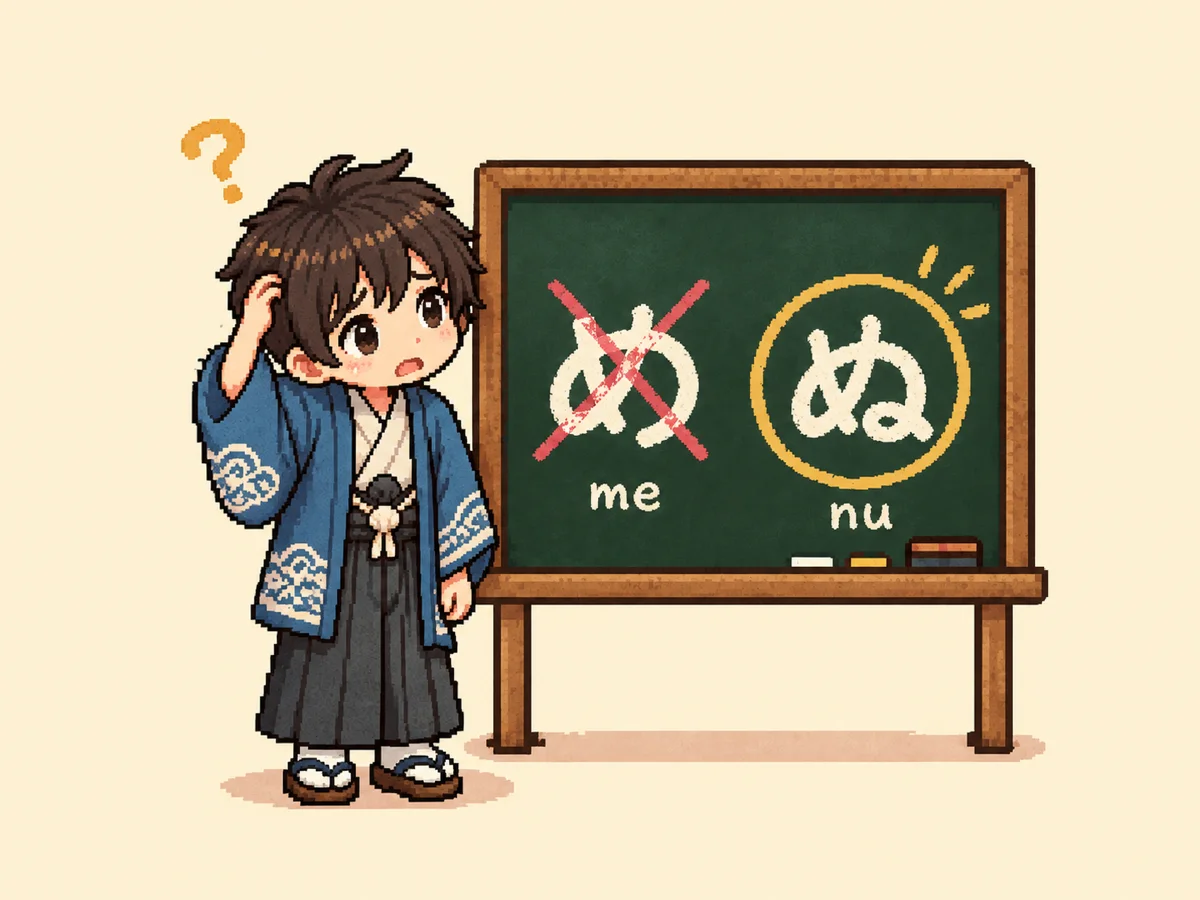
About two weeks into learning hiragana, I was convinced I had ぬ and め figured out. I'd seen them dozens of times. I could pick either one out of a chart without hesitating. Then I switched to quiz mode — cards with no other characters around them — and I got them wrong almost every time. Same with わ, ね, and れ. I thought I knew them. I didn't. What I had was recognition built on context clues, not actual memory of the characters themselves. That distinction cost me a lot of wasted study time.
Here's what I wish I'd known earlier — both the mistakes I made and the ones I kept watching other learners hit after I built Hirakata.
The overload problem
Trying to learn all 46 hiragana at once is the most common mistake, and it's a genuine pace-killer. Your memory doesn't work like a hard drive — you can't just dump information in and expect it to stay. Cramming produces short-term recall that evaporates fast.
Learn 5–10 characters per day, one row at a time, and review yesterday's before adding anything new. It feels slow at first. It isn't. You'll actually retain things this way, which is the whole point. Spaced repetition — revisiting characters at increasing intervals — is what moves them from short-term to long-term memory. The shuffle mode in Hirakata helps by mixing up the order, so you can't lean on a character's position in the row.
The similar-character trap
This one got me for weeks. Some characters look nearly identical, especially before your eye has had time to develop pattern recognition for the writing system:
- ね (ne) vs れ (re) vs わ (wa)
- め (me) vs ぬ (nu)
- は (ha) vs ほ (ho)
- コ (ko) vs ロ (ro) in katakana
The mistake I kept making was studying these characters separately, which meant I only discovered the confusion during quizzes. Study look-alike pairs side by side instead. The difference is obvious when you have both on screen at once; it disappears when you're working from memory alone. The Review mode in Hirakata shows all characters in a grid — I specifically use it for this kind of comparison before drilling.
Writing and stroke order
I'd argue writing practice is more important than most digital-first learners give it credit for. Actually forming the characters by hand builds a kind of muscle memory that makes recognition faster and more automatic. It's also what lets you read handwritten Japanese, which looks nothing like printed text if you haven't practiced the strokes yourself.
Stroke order matters here, though I wouldn't make it a blocker. The basic rules cover most characters: top to bottom, left to right, horizontal before vertical. Get those right and you'll be correct most of the time. The main payoff is writing speed and legibility — once stroke order becomes automatic, you stop having to think about it. Bad habits are much harder to fix later than to build correctly from the start.
When you practice writing, write from memory rather than by copying. Copying feels productive but it's mostly just tracing. Write the character, then flip the card over to check. That friction is what makes it stick.
Hiragana vs katakana
A lot of beginners aren't sure when each system is used, and honestly the confusion is understandable — they represent the same sounds. The division is roughly: hiragana for native Japanese words, grammar particles, and verb endings; katakana for foreign loanwords, borrowed terms, emphasis, and onomatopoeia. You'll see both constantly once you start reading real Japanese, so it's worth getting clear on this early.
I'd say don't try to learn both systems simultaneously. Finish hiragana first, get solid recognition on all 46, then move to katakana. Mixing them at the start just doubles the confusion. Katakana is noticeably harder anyway — the characters are more angular and several share similar shapes that trip people up — so give hiragana the time it needs before you add the second system.
Dakuten and contracted sounds
Once you're comfortable with the basic 46 hiragana, there are two more layers: dakuten (the small diacritic marks that turn か into が, さ into ざ, and so on) and contracted sounds like きゃ, しゅ, ちょ. A lot of beginners either skip these or defer them indefinitely.
Don't skip them. They're essential for reading real Japanese text — you'll hit them within the first few sentences of anything. The good news is that once you know the base characters, dakuten takes most learners 3–5 days. Contracted sounds are another 5–7. They feel like a lot until you're actually doing them, at which point they go fast. In Hirakata you can enable these in the character selection and drill them the same way you learned the basics.
Passive review vs active recall
This is probably the subtlest mistake on this list, and it's one I fell into for a long time. There's a real difference between looking at a character and recognizing it versus seeing a blank card and having to retrieve the reading from memory. The first one feels like learning. The second one actually is.
If your practice is mostly flipping through characters and nodding along, you're building recognition from familiar cues — not recall. Switch to Quiz mode. Test yourself before you review. Write characters from memory. The moment you have to produce an answer rather than confirm one, you're working the right muscle. Effective Learning Tips goes deeper on this if you want to understand the mechanics behind why active recall works.
Consistency over volume
Long gaps between sessions are brutal for retention, and I learned this the hard way. Missing two or three days in the first couple weeks can undo more progress than you'd expect. The characters aren't fully consolidated yet, and without reinforcement they fade quickly.
Ten or fifteen minutes every day is genuinely more effective than an hour on weekends. It doesn't have to be a big deal — pull up Hirakata while you're waiting for something, run a quick quiz before you go to sleep. The habit matters more than the session length. Once you hit reliable daily practice, the progress compounds fast.