Most of what I have told you in this series has been a real fact: a kanji origin, a shared radical, an actual rule for stroke direction. The M-row has one item that is not a fact so much as a lucky accident, and I am going to use it anyway, because it works too well not to. メ, the character, comes from 女 ("woman"). But the Japanese word for eye is め, pronounced exactly like this character. 目 (eye) and 女 (woman) are unrelated words that happen to share a sound, and メ rode in on the wrong one. Doesn't matter. "Me" sounds like "eye," メ looks enough like a closed eye or an X marking a spot, and the sound sticks regardless of which kanji is technically responsible.
The rest of the row is more straightforward, and by the end of it you will have thirty-five of katakana's forty-six base characters down.
Where these shapes come from
マ is cut from 万 ("ten thousand"), the character every large Japanese number eventually routes through. ミ echoes 三 ("three"), one of the first kanji anyone learns, since 一, 二, 三 (one, two, three) are as simple as kanji get and you already have ニ from the N-row to compare it against. モ comes from 毛 ("hair, fur"), which shows up in 毛布 (mōfu, blanket) and animal names. None of these need to be memorized as kanji right now, but noticing the pattern, that katakana keeps recycling the same handful of source characters, makes each new row feel less like forty-six unrelated puzzles and more like variations on maybe a dozen root shapes.
マ (ma)

マ (ma)
マ is a fragment of 万 (man, "ten thousand"): a horizontal stroke across the top, then a stroke that drops and curves under, hooking back left. Recall the very first look-alike note in this series, back in Vowels: マ is the character with the full bar across the top, where ア has only a short tick.
Hook: a small sailboat. The horizontal is the boom, the curved stroke is the hull riding low in the water.
Stroke path: a horizontal left to right that bends at its right end and sweeps down to the lower left in one motion, like フ. Then a short stroke inside the bend, slanting down to the right. Two strokes.
Sound: "m" plus the "ah" from ア.
ミ (mi)
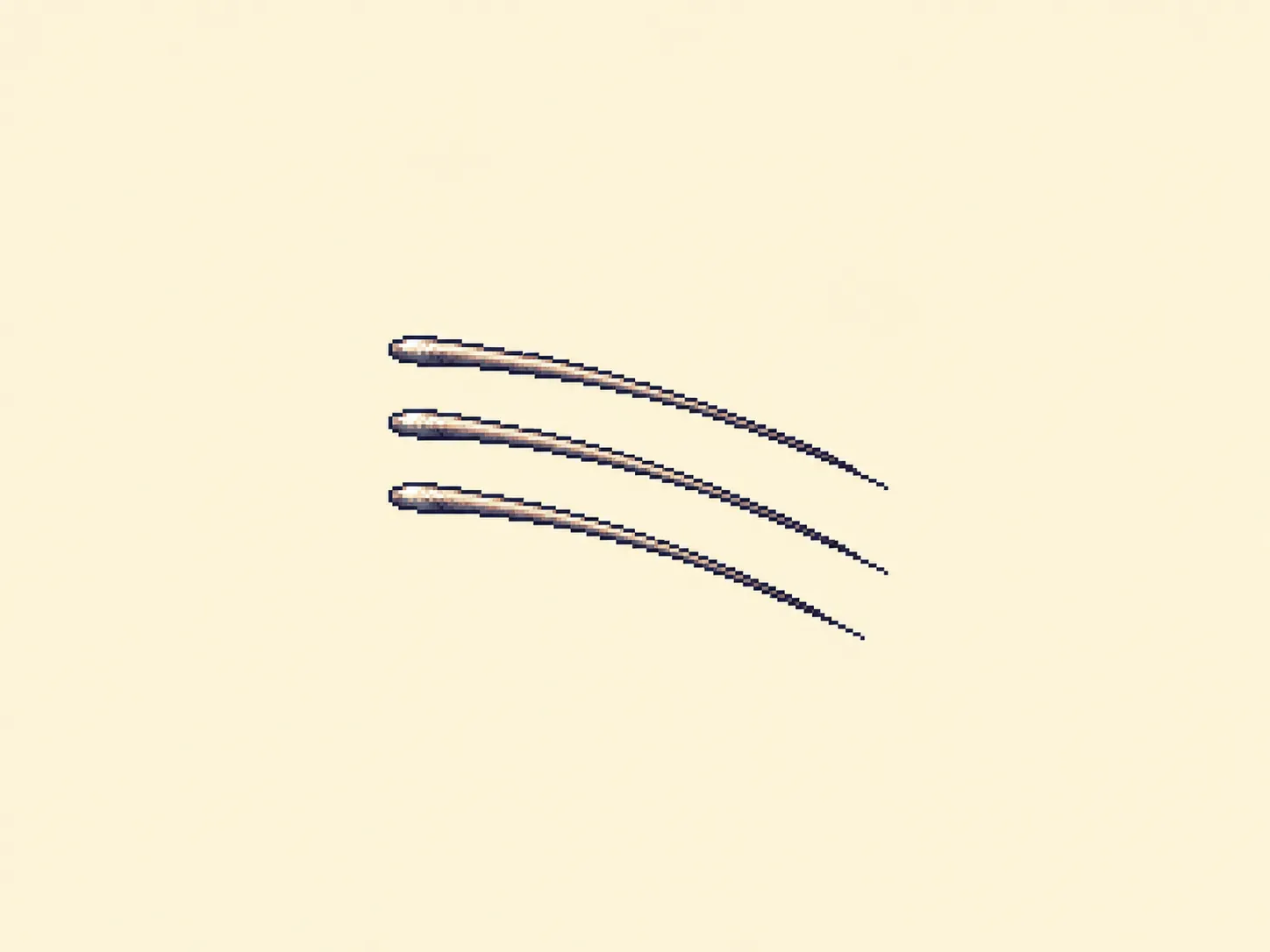
ミ (mi)
ミ is close to the kanji 三 (san, "three"): three short strokes, roughly parallel, stacked with a slight downward slant. It is worth saying plainly that ミ is not a member of the シ/ツ/ソ/ン family from earlier rows. Those are one or two short strokes plus one long sweeping stroke. ミ has three short strokes and no long one at all. Different shape family entirely, even though the stroke count feels similar.
Hook: three whiskers, evenly spaced, angled the way a cat's whiskers fan out from its cheek. "Mi" as it twitches its nose.
Stroke path: three short strokes, top to bottom, each slanting down and to the right, roughly parallel. Three strokes.
Sound: "m" plus the "ee" from イ.
ム (mu)

ム (mu)
ム is a fragment of 牟, and this is the rare case where the sound itself is the mnemonic. A cow says "moo." ム is "mu." Close enough that most learners land on this one independently. The shape, one long folded stroke closed off by a short tick, reads reasonably well as a simple triangular cow's snout.
Hook: a cow's face, front-on, saying "mu." It is a rare case in this series where I would tell you to skip the shape story entirely and just remember the sound. Some characters need a picture because the sound alone gives you nothing to hold onto. This one does not.
Stroke path: a long stroke that starts at the top, slants down to the left, then turns sharply and runs right along the bottom, rising slightly. Then a short stroke at the lower right, slanting down to the right to close the corner. Two strokes.
Sound: "m" plus the short "oo" from ウ.
メ (me)
メ (me)
メ is two diagonal strokes crossing into an X. It is a fragment of 女 ("woman"), but the useful fact is the coincidence from the opening: め and メ are pronounced exactly like 目, the kanji for "eye." An X can double as a stylized closed eye, lashes crossing at the center.
Against ナ: ナ is a plus sign, one stroke crossing another at a right angle. メ is an X, both strokes on the diagonal. Right angle versus X.
Stroke path: a long diagonal sweeping from upper right to lower left, like ノ, then a shorter stroke from upper left to lower right, crossing it. Two strokes.
Sound: "m" plus the "eh" from エ.
モ (mo)

モ (mo)
モ is a fragment of 毛 (mō, "hair" or "fur"), and it shares the two horizontal bars of テ. The difference is the vertical. In テ it hangs from the lower bar. In モ it starts at the top bar, cuts through the lower one, and curves out to the right at the bottom.
Hook: a mop. "Mo" as in "mop," and 毛 (hair, fur) is exactly the kind of shaggy material a mop is made of. The two horizontal strokes are two bands wrapping the mop head.
Stroke path: a short horizontal at the top, a longer horizontal below it, then a vertical that starts on the top bar, drops through the lower one, and curves out to the right at the bottom. Three strokes.
Sound: "m" plus the "oh" from オ.
The look-alikes that live here
- マ (ma) vs ア (a). Full horizontal bar across the top means マ. A short tick set apart from the rest means ア. This is the very first pairing this series flagged, back in the vowels article, and now both halves are learned.
- メ (me) vs ナ (na). X shape crossing on the diagonal: メ. Plus shape crossing at a right angle: ナ.
- ミ (mi) vs the シ/ツ/ソ/ン group. Three short parallel strokes with no long sweep: ミ. Short strokes plus one long sweeping stroke: any of シ, ツ, ソ, ン (two short strokes for シ and ツ, one for ソ and ン). If nothing in the shape is long, it cannot be that group.
- モ (mo) vs テ (te). Both have two horizontal bars. In モ the vertical starts at the top bar and cuts through the lower one. In テ it hangs from the lower bar and nothing crosses it.
- ム (mu) vs 厶. ム appears on its own here; the same shape as a component (厶) shows up inside kanji like 私 (watashi, I) later on, which is a small preview worth filing away.
Reading real words
Thirty-five characters now. Every word below is built only from Vowels, K, S, T, N, H, and M-row characters, plus the ー bar.
| Word | Reading | Meaning |
|---|---|---|
| マスク | masuku | mask |
| ミス | misu | mistake, "miss" |
| チーム | chīmu | team |
| メモ | memo | memo, note |
| トマト | tomato | tomato |
| タイム | taimu | time, as in a sports timing |
| ハム | hamu | ham |
| ホーム | hōmu | (train station) platform, from "home" |
メモ is worth a second look: メ then モ, back to back, the X and the two-bar shape you just spent this whole article telling apart. If you can read メモ without hesitating on either character, the row has landed. ホーム is a good reminder that borrowed words do not always keep their English meaning. A platform at a train station, not a house.
Two more the slow way:
- マスク. マ is "ma." ス is "su." ク is "ku." ma-su-ku. Mask. The English "-sk" cluster becomes "su-ku," the same vowel-insertion pattern you have now seen in nearly every word in this series.
- トマト. ト is "to." マ is "ma." ト again. to-ma-to. Tomato, read almost exactly like the English word, just with each consonant given its own full beat. Words that map this cleanly onto their English source are rare enough to enjoy when they show up.
Drilling the M-row
マ needs one check against ア and you are done with it. メ and ナ get a Match round together, X against plus, until you stop needing to think about it. ミ deserves a few reps purely to build the muscle memory that it is three short strokes, not short strokes plus a sweep, especially if シ, ツ, ソ, ン are still fresh enough to interfere. モ and テ are worth one side-by-side pass, watching where the vertical starts. Then run the whole row in Hirakata's Study mode start to finish, twice, with a short break between passes.
By this point in the series you have enough characters that a full Match round, all seven rows learned so far mixed together, is genuinely worth the ten minutes it takes. It will feel slower than drilling one row at a time, and that is the point: real reading never comes with the characters pre-sorted by row, so practicing them scrambled is closer to the actual skill than practicing them in the order you memorized them.
Practice before moving on
Before the Y-row, check that you can:
- Write all five M-row characters from memory, in order
- Tell マ from ア by the top stroke, and メ from ナ by the crossing angle
- State why ミ is not part of the シ/ツ/ソ/ン family
- Read メモ and チーム without slowing down
- Read all eight practice words above at a normal pace
Where to go from here
The Katakana Y-Row is next, a short one with only three characters, ヤ, ユ, ヨ. For the hiragana version of this row, see Hiragana M-Row. If the メ and 目 coincidence was fun, Understanding Katakana has more on how sound and meaning interact once you start layering in real vocabulary, and it is worth rereading now that thirty-five characters in, most of what it warned about will feel familiar rather than abstract. Drill マ, ミ, ム, メ, モ in Hirakata's Study and Match modes, with the vowels and N-row switched on.