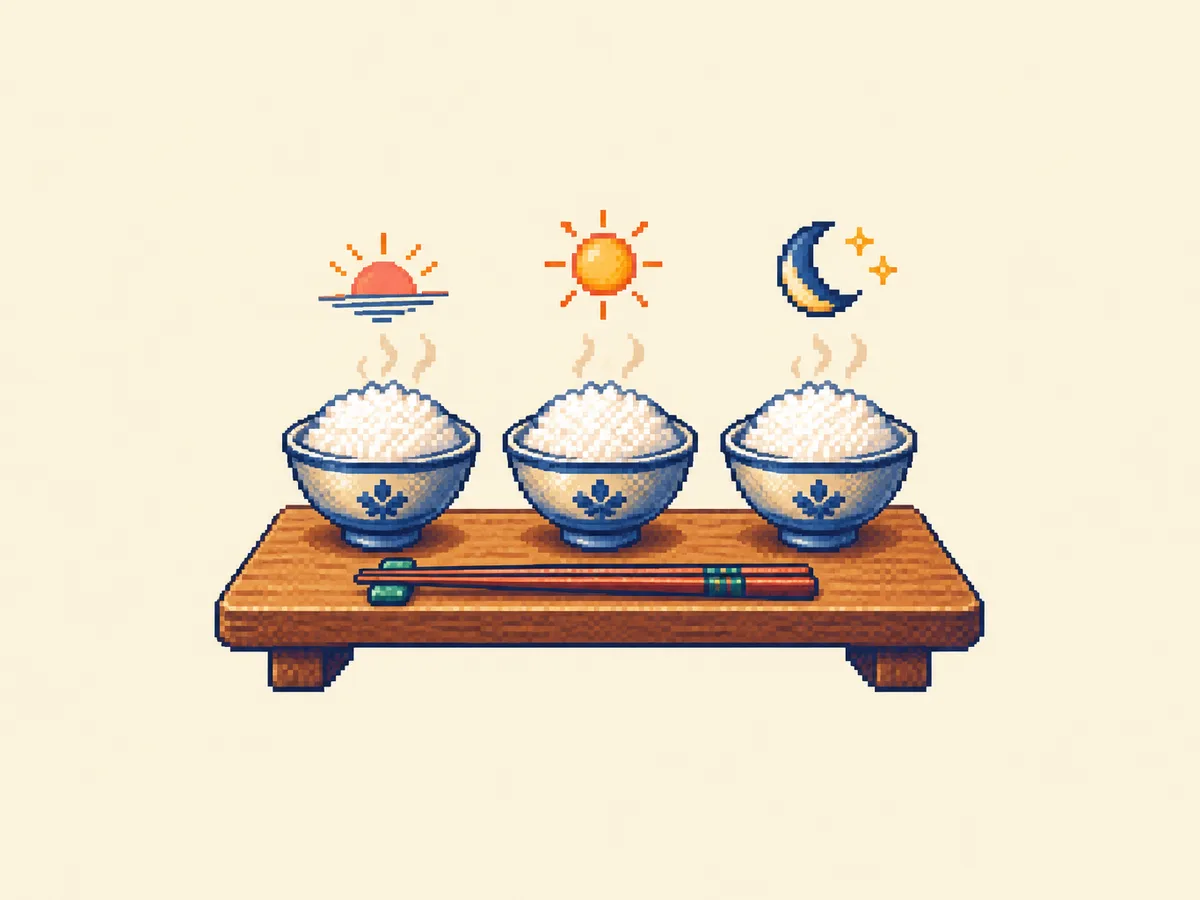
The first full sentence I ever said to a Japanese person without rehearsing it was about breakfast. My host mother in Osaka asked me something at the kitchen table, and the only word I caught was 朝ご飯 (asagohan). I panicked, pointed at my toast, and said "パン、食べます" (pan, tabemasu). Bread, I eat. She laughed, nodded, and handed me the jam. It wasn't elegant. It worked.
That's the reason this series starts with meals. Food is the topic you'll actually talk about every single day, and the words are some of the most useful on the entire JLPT N5 list. Over eight lessons we'll go from the meals of the day to ordering at a restaurant, the kitchen, table manners, and then breakfast, lunch, dinner, and dessert one at a time. Every lesson uses words from the N5 vocabulary list and adds one or two grammar points you can practice with the exercises at the end.
In this first lesson you'll learn the three meals, the time-of-day words they're built from, and the single sentence pattern that carries the rest of the series.
The secret: ご飯 means both "rice" and "meal"
Before the meal words make sense, you need one word: ご飯 (gohan). On its own, ご飯 means cooked rice. It also means "a meal." That double meaning tells you a lot about how central rice has been to Japanese eating. For most of history, a meal without rice wasn't really a meal.
The N5 list writes it as 御飯, with the kanji 御 at the front. You'll almost never see that spelling in real life. Menus, textbooks, and convenience-store labels almost always use ご飯 with hiragana ご. Learn to recognize both, but write ご飯.
The ご at the front is an honorific prefix that makes the word sound polite and gentle. You'll meet its cousin お in a lot of food words: お茶 (ocha, tea), お菓子 (okashi, sweets), お皿 (osara, plate). Food words collect these polite prefixes more than almost any other category.
The three meals
Here's where it gets easy. Each meal is just a time of day plus ご飯.
| Japanese | Reading | Meaning | Literally |
|---|---|---|---|
| 朝ご飯 | asagohan | breakfast | "morning rice" |
| 昼ご飯 | hirugohan | lunch | "noon rice" |
| 晩ご飯 | bangohan | dinner | "evening rice" |
| 夕飯 | yūhan | dinner, evening meal | "evening meal" |
| 夕ご飯 | yūgohan | dinner (softer, not N5) | "evening rice" |
朝 (asa) is morning, 昼 (hiru) is noon or daytime, and 晩 (ban) is evening. Once you see the pattern, you can't unsee it.
The last two rows are the other dinner words you'll run into. 夕飯 is on the N5 list, and its 夕 (yū) is the evening kanji from 夕方 (yūgata, early evening). 夕ご飯 is the same idea, a little softer. It isn't on the N5 list, but it's very common in speech.
晩ご飯 and 夕飯 mean the same thing in practice. My host family used 晩ご飯 and my coworkers mostly said 夕飯, and nobody ever blinked at either one. Pick one and use it.
One thing to notice: 夜 (yoru, night) has no standard meal word. 夜ご飯 isn't on the N5 list. You'll hear it in casual speech, but 晩ご飯 is the standard.
Time words that go with meals
Meals rarely come up alone. You eat breakfast every morning, you skipped lunch this afternoon, you're having dinner tonight. These N5 words do that work.
| Japanese | Reading | Meaning |
|---|---|---|
| 朝 | asa | morning |
| 昼 | hiru | noon, daytime |
| 夕方 | yūgata | early evening, dusk |
| 晩 | ban | evening |
| 夜 | yoru | night |
| 今朝 | kesa | this morning |
| 今晩 | konban | this evening, tonight |
| 毎朝 | maiasa | every morning |
| 毎晩 | maiban | every night |
| 午前 | gozen | a.m., morning |
| 午後 | gogo | p.m., afternoon |
Two of these deserve a warning. 今朝 is read kesa, not ima-asa. It's an irregular reading and you just have to memorize it. 今晩 (konban) should look familiar: it's the first half of こんばんは (konbanwa, good evening). That greeting is literally "as for this evening."
The pattern: something を 食べます
Now the grammar. Here is the sentence that runs this whole series:
パンを食べます。 (Pan o tabemasu.) I eat bread.
Three pieces:
- パン (pan): bread. The thing being eaten.
- を (o): the object particle. It marks the thing the verb acts on. It's written with the hiragana を but pronounced o.
- 食べます (tabemasu): eat. This is the polite form of 食べる (taberu, to eat).
Japanese puts the verb at the end. The object comes first, then を, then the verb. English says "I eat bread." Japanese says "bread を eat." Notice there's no "I" either. When it's obvious who's eating, Japanese leaves it out.
Swap the verb to talk about drinks:
お茶を飲みます。 (Ocha o nomimasu.) I drink tea.
飲みます (nomimasu) is the polite form of 飲む (nomu, to drink). With just 食べます and 飲みます, you can already talk about most of what's on a table.
Saying you don't eat something
The negative swaps ます for ません:
- 食べます (tabemasu): eat → 食べません (tabemasen): don't eat
- 飲みます (nomimasu): drink → 飲みません (nomimasen): don't drink
朝ご飯を食べません。 (Asagohan o tabemasen.) I don't eat breakfast.
That sentence got me a very worried look from my host mother, by the way. Skipping breakfast is a bigger deal in a lot of Japanese households than it is in mine.
Asking a question
Add か (ka) to the end and the sentence becomes a question. No word-order change, no extra helper verb.
コーヒーを飲みますか。 (Kōhī o nomimasu ka.) Do you drink coffee?
何を食べますか。 (Nani o tabemasu ka.) What will you eat? / What do you eat?
何 (nani, what) slots right into the object position. Whatever you'd answer goes in the same spot: 何を食べますか → パンを食べます.
Putting time words in the sentence
Time words usually go at the front of the sentence, before the object.
毎朝、パンを食べます。 (Maiasa, pan o tabemasu.) I eat bread every morning.
今晩、何を食べますか。 (Konban, nani o tabemasu ka.) What are you eating tonight?
You might be wondering about に (ni), the particle you use with clock times like 七時に (shichiji ni, at seven o'clock). Here's the rule that prevents a lot of beginner mistakes: general and relative time words usually don't take に. 朝, 毎朝, 今朝, 今晩, 毎晩: no に. Specific times do: 七時に, 月曜日に (getsuyōbi ni, on Monday).
- Right: 毎晩ご飯を食べます。 (Maiban gohan o tabemasu.) I eat dinner every night.
- Wrong: 毎晩にご飯を食べます。
- Right: 七時に朝ご飯を食べます。 (Shichiji ni asagohan o tabemasu.) I eat breakfast at seven.
If you want a refresher on days of the week and clock-style time words, How to Say Dates, Months, and Days of the Week in Japanese covers them.
Food and drink: the two umbrella words
Two more N5 words are built straight from the verbs you just learned:
- 食べ物 (tabemono): food. Literally "eat thing."
- 飲み物 (nomimono): drink, beverage. Literally "drink thing."
物 (mono) means "thing." Stick it on the stem of a verb and you get a noun for the thing you do that verb to. You'll see 飲み物 on every menu in Japan as the heading for the drinks section.
飲み物は何ですか。 (Nomimono wa nan desu ka.) What's the drink? / What's to drink?
More words from this lesson
Every other word that came up in this lesson, in one place. All of them are on the N5 list.
| Japanese | Reading | Meaning |
|---|---|---|
| ご飯 | gohan | cooked rice, a meal |
| 食べる | taberu | to eat |
| 飲む | nomu | to drink |
| 食べ物 | tabemono | food |
| 飲み物 | nomimono | drink, beverage |
| パン | pan | bread |
| お茶 | ocha | tea |
| コーヒー | kōhī | coffee |
| お菓子 | okashi | sweets, snacks |
| お皿 | osara | plate, dish |
| 何 | nani | what |
| 月曜日 | getsuyōbi | Monday |
Practice exercises
Tap each one to check your answer. Try to say the answer out loud before you look.
Fill in the particle
パン___食べます。 (I eat bread.)
を (o). パンを食べます。 (Pan o tabemasu.)毎朝、コーヒー___飲みます。 (I drink coffee every morning.)
を (o). Note that 毎朝 itself takes no particle.七時___朝ご飯を食べます。 (I eat breakfast at seven.)
に (ni). Specific clock times take に.今晩___何を食べますか。 (What are you eating tonight?)
No particle. 今晩 is a relative time word, so it stands on its own: 今晩、何を食べますか。
Make it negative
朝ご飯を食べます。
朝ご飯を食べません。 (Asagohan o tabemasen.) I don't eat breakfast.お茶を飲みます。
お茶を飲みません。 (Ocha o nomimasen.) I don't drink tea.
Translate into Japanese
What do you eat for lunch? (Hint: start with 昼ご飯に)
昼ご飯に何を食べますか。 (Hirugohan ni nani o tabemasu ka.) Here に marks "for/as lunch."I eat dinner every night.
毎晩、晩ご飯を食べます。 (Maiban, bangohan o tabemasu.) 夕飯 (yūhan) works in place of 晩ご飯 too.Do you drink coffee every morning?
毎朝、コーヒーを飲みますか。 (Maiasa, kōhī o nomimasu ka.) To ask about this morning you'd need the past tense, which is coming in Part 5.
Reading check
How do you read 今朝?
kesa. It's an irregular reading, not ima-asa.What does 飲み物 literally mean?
"Drink thing." 飲み (nomi, from 飲む) + 物 (mono, thing). It means beverage.
Where to go from here
Next up is Part 2: Ordering Food in Japanese, where you'll take を and turn it into the most useful restaurant phrase there is: something をください. If any of the kana in this lesson slowed you down, run a few rounds of the Hirakata flashcards first, and the N5 vocabulary deck has every N5 word from this series with furigana.