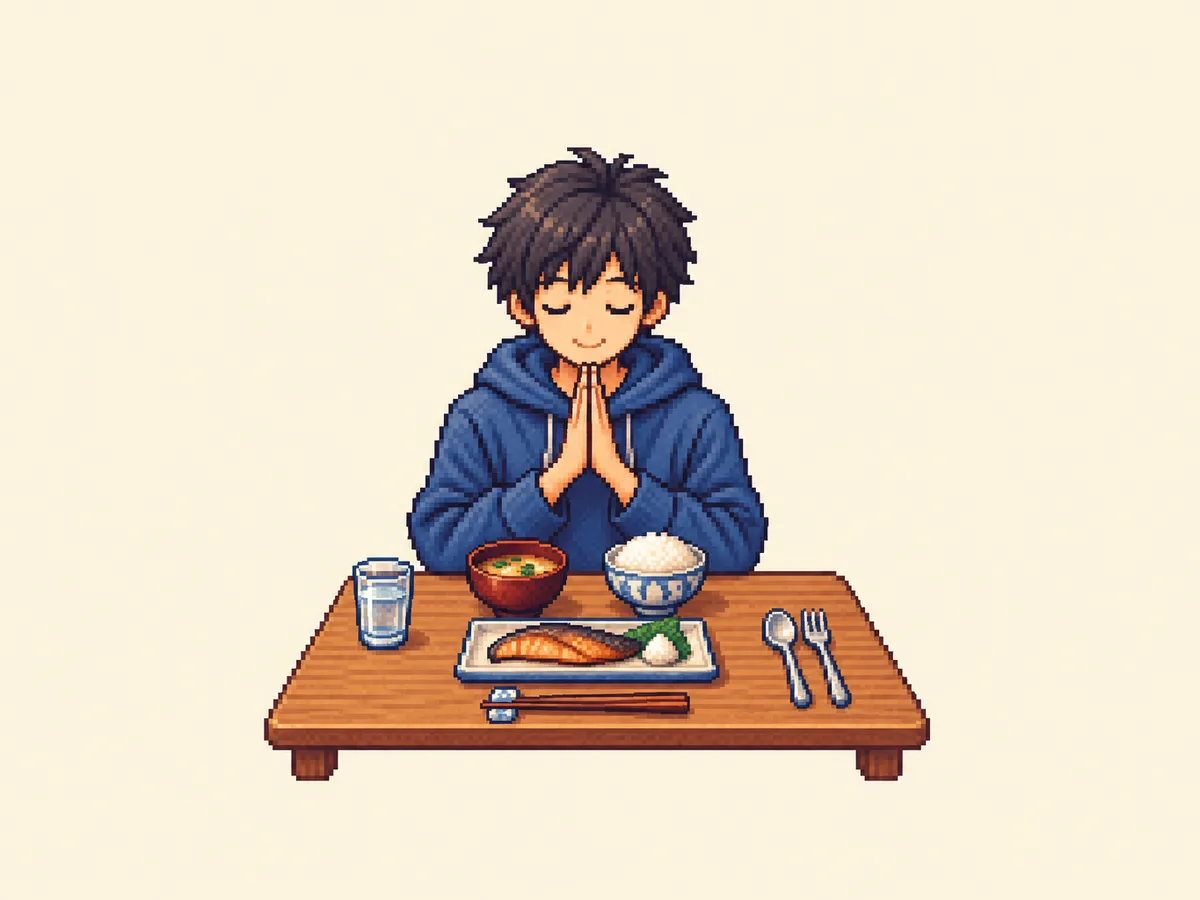
The first time I ate with coworkers in Japan, I picked up my chopsticks and started eating. Then I noticed nobody else had. Six people were sitting with their hands together, looking at me, waiting. Someone said いただきます (itadakimasu), everyone echoed it, and then they started. I mumbled it a beat late with a mouthful of rice. Nobody said anything. I never forgot again.
The words you say at the table are some of the first Japanese most people learn, and some of the most misunderstood. This lesson covers what to say before and after eating, the N5 words for everything on the table, and two grammar points: the particle で for "with" and the い-adjectives you use to say how food tastes.
This is Part 4 of the series. Part 3 covered the kitchen and pantry.
Before you eat: いただきます
いただきます (itadakimasu) is said right before you start eating. You'll often see people put their palms together while saying it, though plenty of people just say it.
It usually gets translated as "let's eat" or "bon appétit," but neither is right. いただきます comes from the humble verb いただく (itadaku), "to receive." Literally it's closer to "I humbly receive." You're acknowledging the food, the people who made it, and in a traditional sense the life that went into it. It's not an invitation to other people to start eating. You say it for yourself.
That means you say it even when you're eating alone. A lot of people in Japan say a quiet いただきます before a convenience-store bento at their desk. Nobody's listening. It's a habit, like saying "bless you."
After you eat: ごちそうさまでした
When you finish, you say ごちそうさまでした (gochisōsama deshita). Casually, just ごちそうさま (gochisōsama).
ごちそう (gochisō) means a feast or a treat. The phrase is roughly "that was a feast," a thank-you to whoever cooked or paid. You say it at home when you finish, and it's polite to say it to the staff on your way out of a restaurant, especially a small one. The chef at a ramen counter will often call back ありがとうございました (arigatō gozaimashita).
If someone treats you to a meal, ごちそうさまでした is also how you thank them afterward. Even the next day: "Thanks for dinner last night" is just ごちそうさまでした.
Utensils and dishes
Here are the N5 words for what's on the table.
| Japanese | Reading | Meaning |
|---|---|---|
| 箸 | hashi | chopsticks |
| スプーン | supūn | spoon |
| フォーク | fōku | fork |
| ナイフ | naifu | knife |
| お皿 | osara | plate, dish |
| ちゃわん | chawan | rice bowl, tea bowl |
| コップ | koppu | glass, cup (for cold drinks) |
| カップ | kappu | cup (for hot drinks) |
A few things worth knowing.
箸 (hashi) is spelled the same in romaji as 橋 (hashi, bridge) and 端 (hashi, edge). Only the pitch accent tells them apart. In standard Japanese, chopsticks are HA-shi (high-low) and bridge is ha-SHI (low-high). You'll be understood either way because context makes it obvious. You'll also hear お箸 (ohashi) with the polite お.
お皿: the bare word is 皿 (sara), but in conversation almost everyone says お皿. You'll see the same thing with お茶 and お菓子.
ちゃわん is the small bowl you eat rice from. The name means "tea bowl," because originally it was for tea. A bowl for rice is technically ご飯ちゃわん, but everyone just says ちゃわん.
コップ vs カップ: both come from foreign words (コップ from the Dutch kop, カップ from English cup). In practice, コップ is a glass or tumbler for water or juice, and カップ is a cup with a handle for coffee or tea. A coffee mug is a マグカップ (magukappu).
Grammar: で means "with" (for tools)
To say what you eat with, use the particle で (de) after the tool.
箸で食べます。 (Hashi de tabemasu.) I eat with chopsticks.
スプーンでカレーを食べます。 (Supūn de karē o tabemasu.) I eat curry with a spoon.
で marks the means or the instrument: the thing you use to do the action. It's the same で in バスで行きます (basu de ikimasu, I go by bus). The tool goes before で, and the whole chunk usually comes before the object.
You can also say it with the verb 使う (tsukau, to use), which is N5:
箸を使います。 (Hashi o tsukaimasu.) I use chopsticks.
フォークを使いますか。 (Fōku o tsukaimasu ka.) Do you use a fork? / Would you like to use a fork?
That second sentence is something you might actually hear at a restaurant if staff think you're struggling. The answer you probably want is いいえ、箸で大丈夫です (Iie, hashi de daijōbu desu, No, chopsticks are fine).
Grammar: saying how it tastes
The most important word at any Japanese table is おいしい (oishii): delicious, tastes good. It's an い-adjective, which means it ends in い and changes form like a verb does.
おいしいです。 (Oishii desu.) It's delicious.
To make it negative, drop the final い and add くない:
おいしくないです。 (Oishikunai desu.) It's not good.
That's the core rule for every い-adjective. Here are the N5 taste and temperature words, all following the same pattern:
| Adjective | Meaning | Negative |
|---|---|---|
| おいしい (oishii) | delicious | おいしくない |
| まずい (mazui) | bad-tasting | まずくない |
| 甘い (amai) | sweet | 甘くない |
| 辛い (karai) | spicy, hot | 辛くない |
| 熱い (atsui) | hot to the touch | 熱くない |
| 冷たい (tsumetai) | cold to the touch | 冷たくない |
| ぬるい (nurui) | lukewarm | ぬるくない |
One irregular to know: いい (ii, good) becomes よくない (yokunai), not いくない. That's the only exception at this level.
Be careful with まずい
まずい is a real word and you'll hear it, but saying it about food someone made for you is rude. Japanese speakers tend to soften negative opinions. If you didn't like something, ちょっと... (chotto..., "it's a little...") with a trailing tone does the job. And おいしくないです is milder than まずいです, though still blunt.
辛い has two meanings
辛い (karai) means spicy. The same kanji read tsurai means painful or hard. On a menu it's always karai. If you see 辛口 (karakuchi) on a curry menu, that's the hot version. 甘口 (amakuchi) is mild.
Asking how it tastes
To ask someone if they like the food:
おいしいですか。 (Oishii desu ka.) Is it good?
Or the more open question with どう (dō, how), an N5 word:
どうですか。 (Dō desu ka.) How is it?
Hosts and staff use the more polite いかがですか (ikaga desu ka), which you met in Part 2. If someone cooked for you, the answer is almost always おいしいです, and they'll be glad you said it.
A few chopstick rules
These aren't grammar, but they come up the first time you eat with Japanese people, so here are the big ones:
- Don't stick chopsticks upright in rice. It's how rice is offered to the dead at funerals.
- Don't pass food from chopsticks to chopsticks. That echoes how bones are passed at a cremation.
- Rest chopsticks on the holder (箸置き, hashioki) when you're not using them. If there isn't one, fold the paper wrapper into a makeshift rest. Laying them across the top of your bowl is considered poor manners, and so is pointing them at people.
- It's fine to lift your bowl. Holding your rice bowl or soup bowl up near your mouth is normal and polite in Japan.
More words from this lesson
Every other word and phrase that came up in this lesson, in one place. The set phrases and 箸置き, マグカップ, 大丈夫, 辛口, and 甘口 aren't on the N5 list.
| Japanese | Reading | Meaning |
|---|---|---|
| いただきます | itadakimasu | said before eating |
| ごちそうさまでした | gochisōsama deshita | said after eating |
| ありがとうございました | arigatō gozaimashita | thank you (for what you did) |
| お箸 | ohashi | chopsticks (polite) |
| 箸置き | hashioki | chopstick rest |
| マグカップ | magukappu | mug |
| 使う | tsukau | to use |
| いい | ii | good |
| どう | dō | how |
| ちょっと | chotto | a little |
| 大丈夫 | daijōbu | fine, okay |
| 辛口 | karakuchi | hot (spicy) version |
| 甘口 | amakuchi | mild version |
| 昨日 | kinō | yesterday |
Practice exercises
Tap each one to check.
What do you say?
You're about to start eating.
いただきます。 (Itadakimasu.)You just finished dinner at a friend's house.
ごちそうさまでした。 (Gochisōsama deshita.)Your boss paid for lunch yesterday. You see them the next morning.
(昨日は)ごちそうさまでした。 ((Kinō wa) gochisōsama deshita.) Thanks for the meal.
Fill in the particle
箸___食べます。 (I eat with chopsticks.)
で (de). The tool takes で.スプーン___カレー___食べます。
で, を. スプーンでカレーを食べます。 I eat curry with a spoon.フォーク___使います。 (I use a fork.)
を (o). With 使う, the tool is the object.
Make it negative
甘いです。
甘くないです。 (Amakunai desu.) It's not sweet.辛いです。
辛くないです。 (Karakunai desu.) It's not spicy.いいです。
よくないです。 (Yokunai desu.) It's not good. The one irregular.冷たいです。
冷たくないです。 (Tsumetakunai desu.) It's not cold.
Translate into Japanese
This curry is delicious.
このカレーはおいしいです。 (Kono karē wa oishii desu.)The coffee is lukewarm.
コーヒーはぬるいです。 (Kōhī wa nurui desu.)Do you eat with a fork?
フォークで食べますか。 (Fōku de tabemasu ka.)
Where to go from here
With the table words covered, the rest of the series goes meal by meal. Part 5: Japanese Breakfast Words starts in the morning and adds the past tense, so you can finally answer "what did you eat?" For more everyday phrases like いただきます, see 5 Essential Japanese Phrases Every Beginner Should Know.