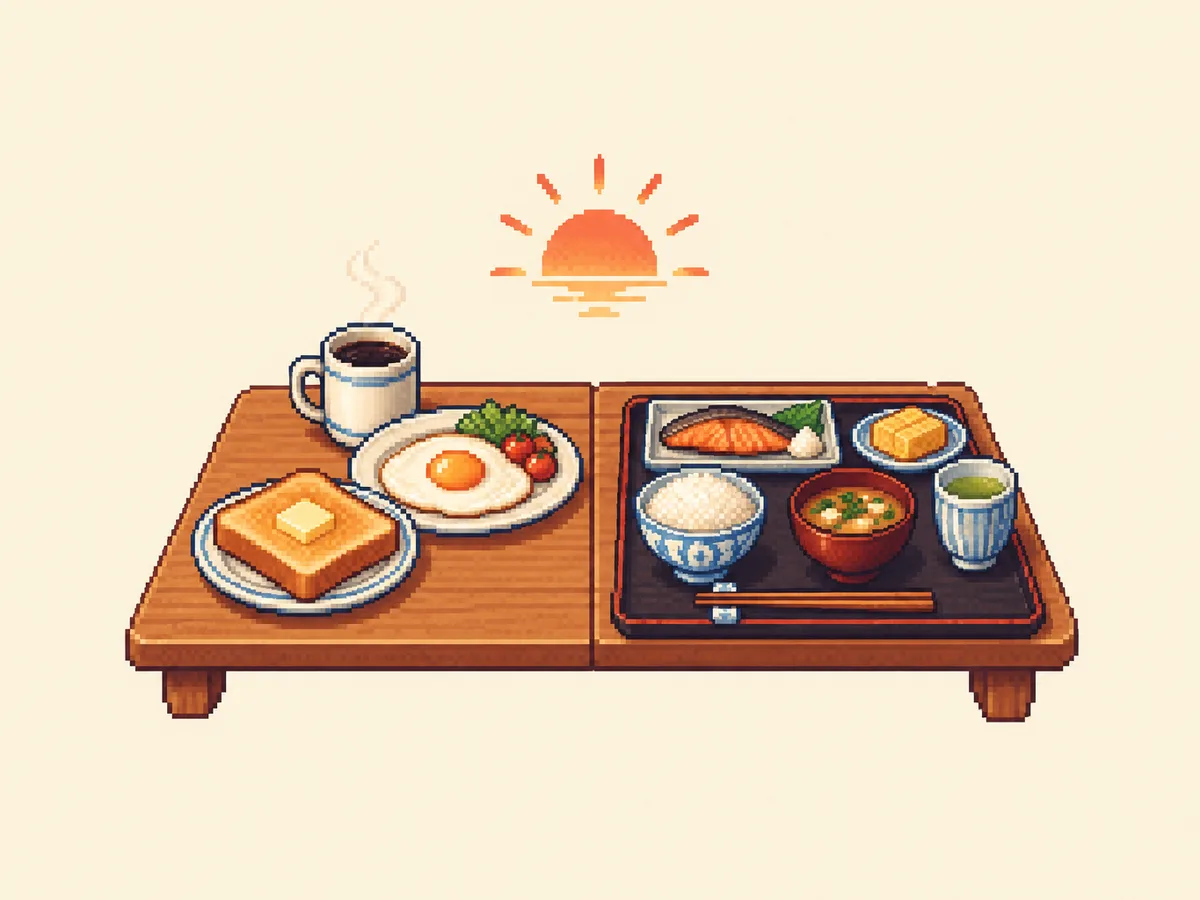
My host family in Osaka had two kinds of breakfast. On weekdays it was toast, a fried egg, and coffee, eaten standing up by half the family because someone was always late. On Sundays my host mother made a proper Japanese breakfast: rice, miso soup, grilled fish, pickles, and a rolled omelet, all in small separate dishes. I loved Sundays. I also learned that Japanese breakfast vocabulary splits into two worlds, and you need words for both.
This lesson covers the breakfast words on the N5 list, a quick tour of what a traditional Japanese breakfast looks like, and the grammar that finally lets you answer the question every Japanese teacher asks on Monday morning: what did you eat?
This is Part 5 of the series. Part 4 covered table phrases and utensils. If 朝ご飯 doesn't look familiar yet, start with Part 1.
Western-style breakfast words
A lot of Japanese households eat a Western-style breakfast on weekdays because it's fast. All of these words are on the N5 list.
| Japanese | Reading | Meaning |
|---|---|---|
| パン | pan | bread, toast |
| バター | batā | butter |
| 卵 | tamago | egg |
| 牛乳 | gyūnyū | milk |
| コーヒー | kōhī | coffee |
| 紅茶 | kōcha | black tea |
| 果物 | kudamono | fruit |
パン looks like katakana for an English word, but it isn't from English. It came from the Portuguese pão in the 1500s, which is why it doesn't sound like "bread." Toast specifically is トースト (tōsuto), but at home most people just say パン.
紅茶 (kōcha) is literally "red tea," which is what Japanese calls black tea. Plain お茶 (ocha) just means tea. In practice, if you order お茶 in Japan, you'll usually get green tea. If you want the English breakfast kind, ask for 紅茶.
Two more breakfast words that aren't on N5 but you'll see everywhere: ヨーグルト (yōguruto, yogurt) and ジャム (jamu, jam). Both are easy to read once you know katakana.
Traditional Japanese breakfast
A traditional breakfast is called 和食 (washoku, Japanese food) or more specifically a 和朝食 (wachōshoku). Most of the individual dishes are above N5, but the building blocks are words you know.
| Japanese | Reading | Meaning | At breakfast |
|---|---|---|---|
| ご飯 | gohan | cooked rice | A bowl of white rice. The center of the meal. |
| 魚 | sakana | fish | Usually a small piece of grilled salmon or mackerel |
| 卵 | tamago | egg | Often a rolled omelet, or raw over rice |
| お茶 | ocha | tea | Usually green tea |
And the bonus words, not N5 but on most traditional breakfast tables:
| Japanese | Reading | Meaning | Notes |
|---|---|---|---|
| 味噌汁 | misoshiru | miso soup | Also written みそ汁 |
| 納豆 | nattō | fermented soybeans | Famously sticky. People either love it or really don't. |
| 漬物 | tsukemono | pickles | |
| 卵焼き | tamagoyaki | rolled omelet | 卵 + 焼き (yaki, grilled). Sweet or savory. |
You'll notice how many breakfast foods are built from N5 words. 卵焼き is just "egg grilled." Once you know 卵, half of the word is already done.
Grammar: the past tense with ました
So far in this series every verb has been in the present: 食べます, 飲みます. To talk about breakfast you already ate, swap ます for ました.
- 食べます (tabemasu): eat → 食べました (tabemashita): ate
- 飲みます (nomimasu): drink → 飲みました (nomimashita): drank
- 作ります (tsukurimasu): make → 作りました (tsukurimashita): made
今朝、パンを食べました。 (Kesa, pan o tabemashita.) I ate bread this morning.
That's the whole change. Every ます verb works the same way. No irregulars at this level.
The negative past: ませんでした
To say you didn't do something, use ませんでした. It's the present negative ません plus でした.
- 食べません (tabemasen): don't eat → 食べませんでした (tabemasen deshita): didn't eat
今朝、朝ご飯を食べませんでした。 (Kesa, asagohan o tabemasen deshita.) I didn't eat breakfast this morning.
Here are all four forms side by side, which is worth memorizing as a block:
| Present | Past | |
|---|---|---|
| Positive | 食べます | 食べました |
| Negative | 食べません | 食べませんでした |
Asking about this morning
Put か on the end like always:
今朝、何を食べましたか。 (Kesa, nani o tabemashita ka.) What did you eat this morning?
朝ご飯を食べましたか。 (Asagohan o tabemashita ka.) Did you eat breakfast?
If the answer is "no, not yet," don't use the past negative. 食べませんでした means you didn't eat, full stop. Instead say いいえ、まだです。 (Iie, mada desu.) "No, not yet." The full version, まだ食べていません (mada tabete imasen), builds on the て-form from Part 7 plus grammar beyond this series, so stick with まだです for now.
Grammar: listing foods with と and や
Breakfast is rarely one thing. In Part 2 you met と (to), which joins nouns as "and."
パンと卵を食べました。 (Pan to tamago o tabemashita.) I ate bread and eggs.
と gives a complete list. It means "bread and eggs, and that's it."
Japanese has a second "and" for lists: や (ya). It means "things like" and suggests the list isn't complete.
パンや卵を食べました。 (Pan ya tamago o tabemashita.) I ate bread, eggs, and stuff like that.
That's a really natural way to talk about meals, because you rarely list every single thing you ate. You'll often see や paired with など (nado, etc.) at the end: パンや卵などを食べました.
The rule of thumb: と for the full list, や for examples.
Bonus: いつも, よく, 時々
Breakfast is a habit, and habits need frequency words. The first four are on the N5 list, and 全然 is common enough that you'll want it anyway.
| Japanese | Reading | Meaning |
|---|---|---|
| いつも | itsumo | always |
| よく | yoku | often |
| 時々 | tokidoki | sometimes |
| あまり | amari | not very often (with ~ません) |
| 全然 | zenzen | never, not at all (with ~ません) |
They usually go right before the object or at the start of the sentence.
いつも朝ご飯にパンを食べます。 (Itsumo asagohan ni pan o tabemasu.) I always eat bread for breakfast.
時々、紅茶を飲みます。 (Tokidoki, kōcha o nomimasu.) I sometimes drink black tea.
Notice that あまり and 全然 only work with a negative verb. あまり食べません means "I don't eat it much." Saying あまり食べます is a mistake.
More words from this lesson
Every other word that came up in this lesson, in one place. The katakana words and 和食 aren't on the N5 list.
| Japanese | Reading | Meaning |
|---|---|---|
| 今朝 | kesa | this morning |
| など | nado | et cetera, and so on |
| いいえ | iie | no |
| まだ | mada | not yet, still |
| 作る | tsukuru | to make |
| トースト | tōsuto | toast |
| ヨーグルト | yōguruto | yogurt |
| ジャム | jamu | jam |
| 和食 | washoku | Japanese food |
Practice exercises
Tap each one to check.
Change to the past tense
パンを食べます。
パンを食べました。 (Pan o tabemashita.) I ate bread.コーヒーを飲みます。
コーヒーを飲みました。 (Kōhī o nomimashita.) I drank coffee.卵を食べません。
卵を食べませんでした。 (Tamago o tabemasen deshita.) I didn't eat eggs.
と or や?
I ate bread and an egg. (Exactly those two things.)
と. パンと卵を食べました。I drink things like coffee and black tea.
や. コーヒーや紅茶を飲みます。
Translate into Japanese
What did you eat this morning?
今朝、何を食べましたか。 (Kesa, nani o tabemashita ka.)I didn't drink milk.
牛乳を飲みませんでした。 (Gyūnyū o nomimasen deshita.)I always drink tea.
いつもお茶を飲みます。 (Itsumo ocha o nomimasu.)I don't eat fish much for breakfast.
朝ご飯にあまり魚を食べません。 (Asagohan ni amari sakana o tabemasen.) あまり needs a negative verb.
Spot the mistake
あまりコーヒーを飲みます。
あまり only works with a negative. It should be あまりコーヒーを飲みません。 I don't drink coffee much.You want English breakfast tea. Do you ask for お茶 or 紅茶?
紅茶 (kōcha). Ask for お茶 (ocha) and you'll usually get green tea.
Where to go from here
Part 6: Japanese Lunch Words heads to the office and the school cafeteria: bento, curry, the で particle for where you eat, and how to invite someone to lunch. If katakana breakfast words like コーヒー and バター are still slow for you, Katakana Loanwords explains the patterns behind them.