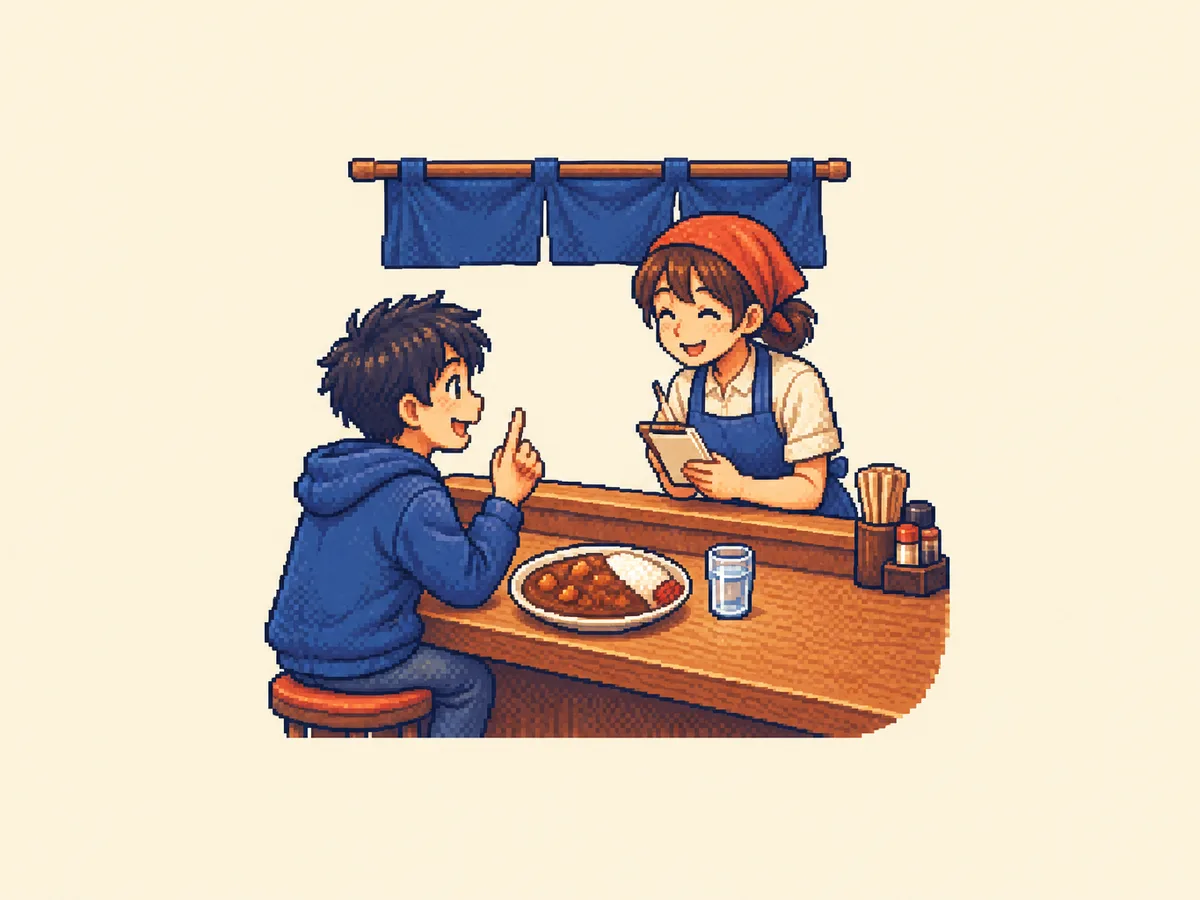
My first solo restaurant meal in Japan was at a tiny curry place near Namba Station. I had practiced my order on the walk there. I sat down, the server came over, and before I could open my mouth she said something fast and friendly that I didn't understand at all. I said カレー (karē) and held up one finger. She smiled, said a few more words I missed, and left. Ten minutes later I had curry. I had no idea what she'd asked me. (It was whether I wanted the regular or large size. I got regular. It was enough.)
What I learned that night is that ordering food has two halves. There's the part you say, which you can rehearse. And there's the part the staff say to you, which is fast, formulaic, and very polite. You need both. This lesson gives you the N5 words and the one ordering pattern that handles almost everything, plus a cheat sheet of what you'll hear back.
This is Part 2 of the series. If you haven't read Part 1 on the meals of the day, it introduces the を particle that this lesson builds on.
Places to eat
The N5 list gives you four words for places that serve food:
| Japanese | Reading | Meaning | Notes |
|---|---|---|---|
| レストラン | resutoran | restaurant | Usually sit-down, often Western-style |
| 食堂 | shokudō | dining hall, cafeteria, set-meal diner | Literally "eating hall" |
| 喫茶店 | kissaten | coffee shop, café | The old-school kind, with dark wood and pour-over coffee |
| 店 | mise | shop, store | Any kind of business, including restaurants |
食堂 is worth knowing for a specific reason. University and company cafeterias are 食堂, and so are the cheap neighborhood places that sell set meals. If you're on a budget, look for 食堂 on the sign.
The ordering pattern: something をください
You met を in Part 1 as the particle that marks what you eat or drink. Now pair it with ください (kudasai), which means "please give me."
カレーをください。 (Karē o kudasai.) Curry, please.
水をください。 (Mizu o kudasai.) Water, please.
That's it. Object, を, ください. This one pattern will get you fed in any restaurant in Japan.
お願いします: the softer version
The other phrase you'll hear constantly is お願いします (onegai shimasu). It means something like "I request it" and works in the exact same slot:
コーヒーをお願いします。 (Kōhī o onegai shimasu.) A coffee, please.
What's the difference? ください is direct: "give me." お願いします is a little softer and more formal. Both are perfectly polite for ordering. In practice, I lean on お願いします in restaurants and ください at a convenience store counter, but you can use either anywhere without a problem.
Counting things: ひとつ, ふたつ
To order more than one of something, you need numbers. Japanese has a general-purpose counter set for "things" that works for almost any food or drink you point at. All ten are on the N5 list.
| Number | Japanese | Reading |
|---|---|---|
| 1 | 一つ | hitotsu |
| 2 | 二つ | futatsu |
| 3 | 三つ | mittsu |
| 4 | 四つ | yottsu |
| 5 | 五つ | itsutsu |
| 6 | 六つ | muttsu |
| 7 | 七つ | nanatsu |
| 8 | 八つ | yattsu |
| 9 | 九つ | kokonotsu |
| 10 | 十 | tō |
At a restaurant you'll rarely need more than three, so lock in ひとつ, ふたつ, みっつ first.
Here's the part that trips up English speakers: the number goes after を, right before the verb.
コーヒーを二つください。 (Kōhī o futatsu kudasai.) Two coffees, please.
English puts the number first: "two coffees." Japanese puts the thing first, then を, then how many, then the verb. Say it out loud a few times. It'll feel backwards for about a week.
Ordering two different things: と
To order two different items, join them with と (to), which means "and" between nouns.
カレーとお茶をください。 (Karē to ocha o kudasai.) Curry and tea, please.
と only connects nouns. You can't use it to join two sentences. For a full list, just keep chaining: カレーとサラダとお茶をください。
Counting people: ひとり, ふたり
When you walk in, the first thing staff want to know is how many people are in your group. People have their own counter:
| Japanese | Reading | Meaning |
|---|---|---|
| 一人 | hitori | one person |
| 二人 | futari | two people |
| 三人 | sannin | three people |
From 三人 on it's regular: number + 人 (nin). 一人 and 二人 are both irregular and both on the N5 list. They're also the two you'll use most. When the server asks, you can answer with just the number: 二人です。 (Futari desu.) Two people.
Asking the price: いくらですか
いくら (ikura) means "how much." Add ですか and you have the question.
これはいくらですか。 (Kore wa ikura desu ka.) How much is this?
The answer will be a number plus 円 (en), yen. You'll want these N5 number words to understand it:
| Japanese | Reading | Meaning |
|---|---|---|
| 円 | en | yen |
| 百 | hyaku | hundred |
| 千 | sen | thousand |
| 万 | man | ten thousand |
Watch out for 万. English counts in thousands (ten thousand, a hundred thousand). Japanese groups by ten-thousands. So 10,000 yen is 一万円 (ichiman en, "one ten-thousand yen"), not 十千円 ("ten thousand yen"). A 1,500-yen lunch set is 千五百円 (sen gohyaku en).
Saying no thanks: 結構です
結構 (kekkō) is on the N5 list with the definitions "splendid" and "enough." The phrase you'll actually use is 結構です (kekkō desu), which is a polite "no thank you" when someone offers you something.
Server: お水はいかがですか。 (Omizu wa ikaga desu ka.) Would you like some water?
You: 結構です。 No thank you.
いかが (ikaga) in that question is another N5 word: a polite way of saying "how about." You'll hear it a lot from staff offering refills.
A small warning. 結構です can also mean "that's fine" in other contexts, and the tone carries a lot of the meaning. A light smile and a small wave of the hand make it a clear "no thanks." If you want to say yes, just say お願いします.
What you'll hear from staff
This is the half nobody rehearses. Most of these words are above N5 level, but you don't need to produce them. You only need to recognize them.
| Japanese | Reading | Meaning | What to do |
|---|---|---|---|
| いらっしゃいませ | irasshaimase | Welcome! | Shouted when you walk in. No reply needed; a nod is plenty. |
| 何名様ですか。 | nanmei-sama desu ka | How many people? | Answer with 一人です or 二人です. |
| お決まりですか。 | okimari desu ka | Have you decided? | Not ready? Say まだです (mada desu, not yet). まだ is N5. |
| 少々お待ちください。 | shōshō omachi kudasai | Please wait a moment. | 待つ (matsu, to wait) is N5, and you know ください now. |
| お会計 | okaikei | the bill | Ready to pay? Say お会計お願いします (okaikei onegai shimasu). |
In a lot of casual places you pay at the register on the way out instead of at the table. If the server leaves a slip on your table, take it to the front.
A full order, start to finish
Here's what a complete lunch looks like with nothing but N5 words and the phrases above.
| Speaker | Japanese | Meaning |
|---|---|---|
| Staff | いらっしゃいませ。何名様ですか。 | Welcome. How many? |
| You | 二人です。 | Two. |
| Staff | お決まりですか。 | Ready to order? |
| You | カレーを二つください。 | Two curries, please. |
| Staff | 飲み物はいかがですか。 | Would you like something to drink? |
| You | 紅茶とコーヒーをお願いします。 | Black tea and coffee, please. |
| You | お会計お願いします。 | The bill, please. |
More words from this lesson
Every other word that came up in this lesson, in one place. お願いします isn't on the N5 list as a single word, but you'll use it daily.
| Japanese | Reading | Meaning |
|---|---|---|
| ください | kudasai | please give me |
| お願いします | onegai shimasu | please (I request it) |
| いくら | ikura | how much |
| これ | kore | this |
| 結構 | kekkō | fine, enough; 結構です = no thank you |
| いかが | ikaga | how about (polite) |
| まだ | mada | not yet, still |
| 待つ | matsu | to wait |
| 水 | mizu | water |
| カレー | karē | curry |
| 紅茶 | kōcha | black tea |
Practice exercises
Tap each one to check. Say your answer out loud first.
Build the order
Water, please. (Use ください)
水をください。 (Mizu o kudasai.)Two coffees, please.
コーヒーを二つください。 (Kōhī o futatsu kudasai.) The number goes after を.Curry and black tea, please. (Use お願いします)
カレーと紅茶をお願いします。 (Karē to kōcha o onegai shimasu.)Three teas, please.
お茶を三つください。 (Ocha o mittsu kudasai.)
Spot the mistake
二つコーヒーをください。 What's unnatural here?
The number is in the wrong place. It should come after を: コーヒーを二つください。 (Putting the number first isn't impossible in Japanese, but it's not how you'd order.)二人人です。 (answering "how many people?")
二人 already includes the person counter. Just say 二人です。 (Futari desu.)
Respond to the staff
Staff: 何名様ですか。 You're alone.
一人です。 (Hitori desu.)Staff: お決まりですか。 You haven't decided yet.
まだです。 (Mada desu.) Not yet.Staff: お水はいかがですか。 You don't want any.
結構です。 (Kekkō desu.) No thank you.
Numbers check
How do you say 1,000 yen?
千円 (sen en). No 一 needed in front of 千 for exactly one thousand.How do you say 10,000 yen?
一万円 (ichiman en). Japanese counts in units of ten thousand.
Where to go from here
Part 3: Kitchen and Pantry Words moves from the restaurant into the home kitchen, with the words for salt, sugar, the fridge, and the grammar for saying where things are. If katakana words like カレー and コーヒー still take you a second to read, Katakana Loanwords explains why they're spelled the way they are, and a few minutes of Hirakata katakana flashcards will speed you up.