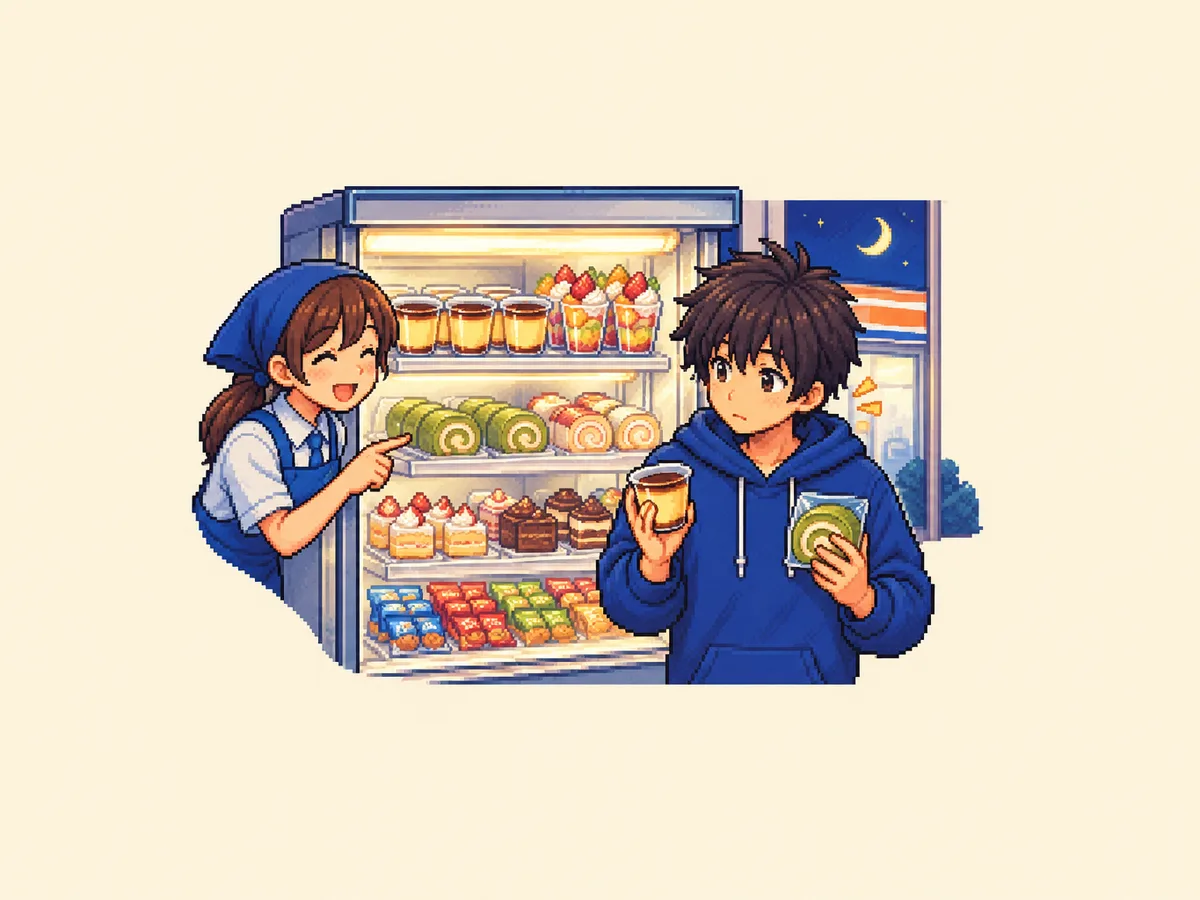
The best Japanese lesson I ever had happened in a convenience store at eleven at night. I was standing in front of the dessert fridge trying to choose between a pudding and a matcha roll cake, and the clerk, who couldn't have been older than nineteen, walked over and said どちらが好きですか (dochira ga suki desu ka), "which one do you like?" I said I didn't know. She pointed at the pudding and said こっちのほうがおいしいです (kocchi no hō ga oishii desu), "this one's better." She was right. I went back for that pudding twice a week for a year.
That one exchange packs in everything in this final lesson: words for sweets and snacks, how to say what you like, and how to compare two things. Desserts are a great topic to end on because they're where people get opinionated, and opinions are where your Japanese starts to sound like you.
This is Part 8, the last lesson in the series. Part 7 covered dinner and the て-form.
Sweets and snacks
| Japanese | Reading | Meaning |
|---|---|---|
| お菓子 | okashi | sweets, snacks, candy |
| 飴 | ame | hard candy |
| 果物 | kudamono | fruit |
| 甘い | amai | sweet |
| 冷たい | tsumetai | cold |
| 紅茶 | kōcha | black tea |
| 喫茶店 | kissaten | café |
お菓子 (okashi) is the big umbrella word. Chips, chocolate, cookies, rice crackers, and candy are all お菓子. The snack aisle in a Japanese supermarket is the お菓子 aisle. Traditional Japanese sweets have their own name, 和菓子 (wagashi), while Western-style cakes and pastries are 洋菓子 (yōgashi). You'll see both on shop signs.
飴 (ame) is hard candy. Careful: it sounds exactly like 雨 (ame, rain), another N5 word, apart from pitch accent. Context sorts it out. Nobody's offering you a handful of rain. Older women in Kansai are famous for carrying candy in their bags and handing it to strangers, and they call it あめちゃん (amechan), with the cutesy ちゃん you'd use for a kid's name.
Bonus words you'll see everywhere
These aren't on the N5 list, but you'll see them on dessert menus everywhere:
| Japanese | Reading | Meaning |
|---|---|---|
| ケーキ | kēki | cake |
| アイスクリーム | aisukurīmu | ice cream. Usually just アイス (aisu). |
| チョコレート | chokorēto | chocolate. Usually just チョコ (choko). |
| プリン | purin | custard pudding. The one from my convenience-store story. |
| 抹茶 | matcha | powdered green tea, a huge dessert flavor in Japan |
| りんご | ringo | apple |
| みかん | mikan | mandarin orange |
Grammar: が好きです
To say you like something, use 好き (suki) with が (ga). Not を.
お菓子が好きです。 (Okashi ga suki desu.) I like sweets.
This trips up nearly everyone, because in English "like" is a verb and sweets are its object. In Japanese, 好き isn't a verb. It's a な-adjective meaning "likeable." So the sentence is closer to "sweets are likeable (to me)." The thing you like takes が.
- Right: 果物が好きです。 I like fruit.
- Wrong: 果物を好きです。
The same pattern works for the other two N5 words in this family:
| Japanese | Reading | Meaning | Example |
|---|---|---|---|
| 好き | suki | like | 果物が好きです。 I like fruit. |
| 大好き | daisuki | love, really like | チョコが大好きです。 I love chocolate. 大 means "big." |
| 嫌い | kirai | dislike, hate | 甘いものが嫌いです。 I don't like sweet things. |
嫌い is strong. Saying 嫌いです about food someone offers you is a bit harsh. The softer way is the negative of 好き: あまり好きじゃないです (amari suki ja nai desu), "I don't really like it."
Asking what someone likes
何が好きですか。 (Nani ga suki desu ka.) What do you like?
甘いものが好きですか。 (Amai mono ga suki desu ka.) Do you like sweet things?
甘いもの (amai mono, sweet things) is how most people talk about desserts in general. もの means "thing," the same 物 from 食べ物 and 果物.
好きな: using it before a noun
Because 好き is a な-adjective, it takes な when it comes before a noun.
好きな果物は何ですか。 (Suki na kudamono wa nan desu ka.) What's your favorite fruit?
Literally "what is the liked fruit?" This is how Japanese asks "favorite." 好きな食べ物 is your favorite food, 好きなお菓子 your favorite snack.
Grammar: が欲しいです
To say you want a thing, use 欲しい (hoshii), again with が.
冷たい飲み物が欲しいです。 (Tsumetai nomimono ga hoshii desu.) I want a cold drink.
欲しい is an い-adjective, so it works exactly like the taste words in Part 4. The negative is 欲しくないです (hoshikunai desu), "I don't want it."
Two things to know about 欲しい:
- It's only for things, not actions. To say you want to do something, you need a different form (食べたい, tabetai, "I want to eat"), which is N4 grammar. For now, 欲しい goes with nouns.
- It's for your own wants. Saying that someone else 欲しい something sounds odd in Japanese, because you can't know what's in their head. Asking someone directly works fine in casual settings: 何が欲しいですか (nani ga hoshii desu ka). With a teacher or a boss, it's more polite to offer instead: 飲み物はいかがですか (nomimono wa ikaga desu ka).
Grammar: comparing two things
Back to that convenience store. To ask someone to pick between two things, use どちら (dochira, which one of two).
ケーキとアイスとどちらが好きですか。 (Kēki to aisu to dochira ga suki desu ka.) Which do you like better, cake or ice cream?
The structure is: A と B と どちらが [adjective] ですか. You'll often hear it with the first と dropped: ケーキとアイス、どちらが好きですか.
To answer, use のほうが (no hō ga), "the side of."
アイスのほうが好きです。 (Aisu no hō ga suki desu.) I like ice cream better.
And to compare directly, add より (yori, than):
ケーキよりアイスのほうが好きです。 (Kēki yori aisu no hō ga suki desu.) I like ice cream more than cake.
Both ほう and より are on the N5 list. This works with any adjective, not just 好き:
果物よりお菓子のほうが甘いです。 (Kudamono yori okashi no hō ga amai desu.) Sweets are sweeter than fruit.
If you can't decide, the answer is どちらも好きです (dochira mo suki desu), "I like both." Honest, and very Japanese.
Series review: what you can say now
Over eight lessons you've picked up a lot of grammar. Here's all of it in one place, with an example from each lesson.
| Part | Grammar | Example |
|---|---|---|
| 1 | を + verb, ます/ません | 朝ご飯を食べません。 |
| 2 | をください, counters, と | コーヒーを二つください。 |
| 3 | にあります, position words | 冷蔵庫の中に卵があります。 |
| 4 | で (tool), い-adjectives | 箸で食べます。おいしくないです。 |
| 5 | ました, ませんでした, や | 今朝、パンや卵を食べました。 |
| 6 | で (place), ませんか, ましょう | 一緒に食堂で食べませんか。 |
| 7 | て-form, てください | 野菜を洗って、切ってください。 |
| 8 | が好き, が欲しい, より/ほうが | ケーキよりアイスのほうが好きです。 |
That's a large share of the core N5 grammar, all in one topic. If you can read every sentence in that table and know why each particle is there, you're in good shape.
More words from this lesson
Every other word that came up in this lesson, in one place. 甘いもの is two N5 words together, and 和菓子 and 洋菓子 aren't on the N5 list.
| Japanese | Reading | Meaning |
|---|---|---|
| 欲しい | hoshii | want (a thing) |
| どちら | dochira | which (of two) |
| 甘いもの | amai mono | sweet things |
| 雨 | ame | rain |
| 後 | ato | after (晩ご飯の後で) |
| 和菓子 | wagashi | traditional Japanese sweets |
| 洋菓子 | yōgashi | Western-style cakes and pastries |
Practice exercises
Tap each one to check.
Fill in the particle
果物___好きです。
が (ga). 好き takes が, not を.冷たいお茶___欲しいです。
が (ga). 欲しい also takes が.ケーキ___アイスのほうが好きです。 (I like ice cream more than cake.)
より (yori). ケーキよりアイスのほうが好きです。
Translate into Japanese
I love sweets.
お菓子が大好きです。 (Okashi ga daisuki desu.) 甘いものが大好きです also works.What's your favorite fruit?
好きな果物は何ですか。 (Suki na kudamono wa nan desu ka.)I want some candy.
飴が欲しいです。 (Ame ga hoshii desu.)Which do you like better, coffee or black tea?
コーヒーと紅茶とどちらが好きですか。 (Kōhī to kōcha to dochira ga suki desu ka.)I like black tea better.
紅茶のほうが好きです。 (Kōcha no hō ga suki desu.)
Soften it
Make this less harsh: 甘いものが嫌いです。
甘いものはあまり好きじゃないです。 (Amai mono wa amari suki ja nai desu.) I don't really like sweet things. (Switching が to は here is also natural when you're contrasting.)
Series review
Say "I ate fruit after dinner." (Hint: 晩ご飯の後で, after dinner)
晩ご飯の後で果物を食べました。 (Bangohan no ato de kudamono o tabemashita.) 後 is N5.Invite someone to go to a café together.
一緒に喫茶店に行きませんか。 (Issho ni kissaten ni ikimasen ka.)Ask someone to please put the sweets on the table.
お菓子をテーブルの上に置いてください。 (Okashi o tēburu no ue ni oite kudasai.)
Where to go from here
That's the end of the food series. If you want to go back through it, Part 1: Meals of the Day is the starting point, and the exercises in each lesson are worth a second pass a week later. To keep the vocabulary fresh, every N5 word in this series is in the N5 vocabulary deck on Hirakata, with furigana, so you can drill them as flashcards. And if you haven't faced a real Japanese menu yet, Katakana Loanwords will make half of it readable on sight.