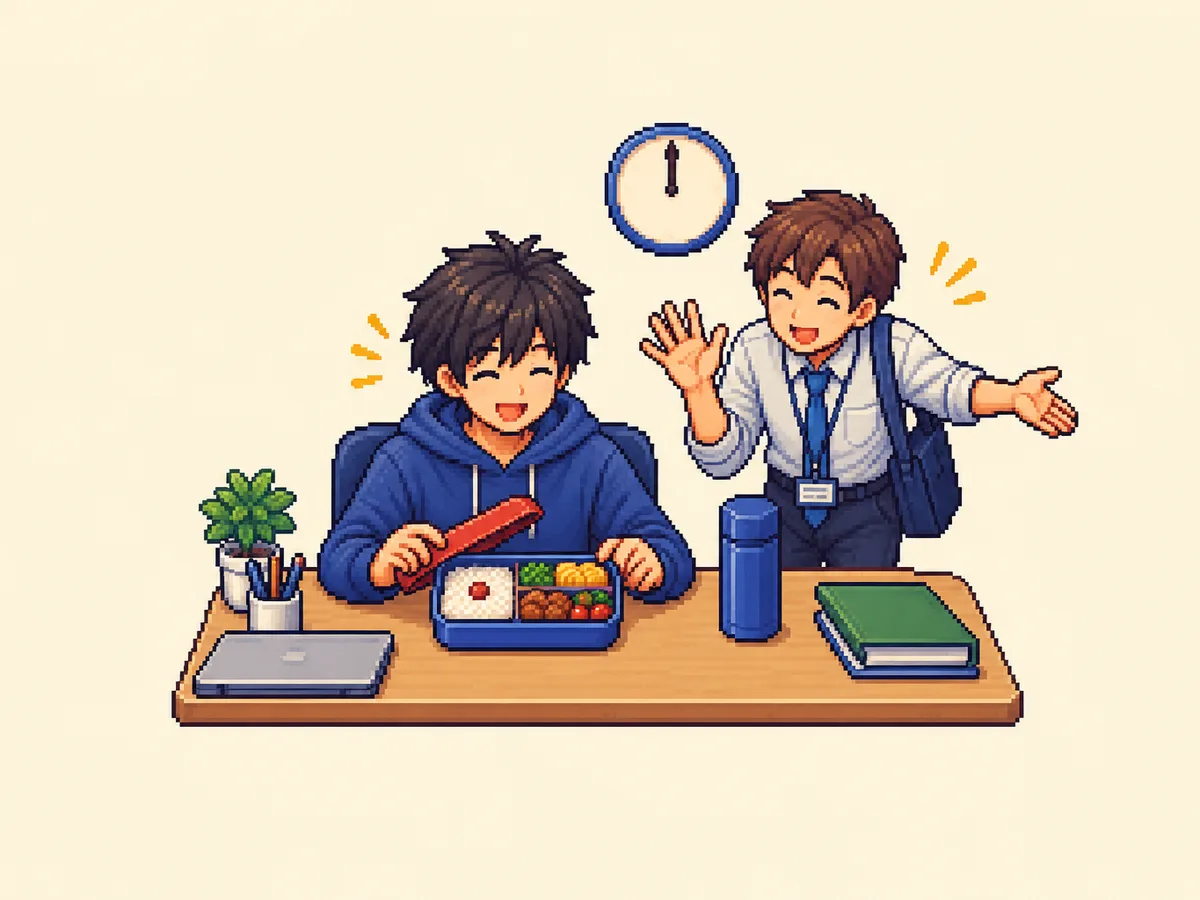
At my first office job in Japan, lunch started at exactly noon. A chime played over the speakers, and within thirty seconds the whole floor split into two groups. One group pulled お弁当 (obentō) out of their bags. The other group stood up and looked around for people to go out with. For the first week I wasn't in either group. Then a coworker leaned over and said 一緒に行きませんか (issho ni ikimasen ka), "won't you come with us?" It was the friendliest sentence I'd heard in weeks, and it's the grammar point at the center of this lesson.
Lunch in Japan is fast, cheap, and social. This lesson covers the N5 words for lunch and the places you eat it, a new use of the particle で, and how to invite someone to eat (and how to say yes).
This is Part 6 of the series. Part 5 covered breakfast and the past tense.
Lunch words
| Japanese | Reading | Meaning |
|---|---|---|
| 昼ご飯 | hirugohan | lunch |
| お弁当 | obentō | boxed lunch, bento |
| カレー | karē | curry (and rice) |
| パン | pan | bread, a sandwich roll |
| 肉 | niku | meat |
| 野菜 | yasai | vegetables |
| 食堂 | shokudō | cafeteria, diner |
| 喫茶店 | kissaten | café |
| 会社 | kaisha | company, office |
| 学校 | gakkō | school |
お弁当 is the polite form of 弁当 (bentō). Like お茶 and お皿, almost everyone says it with the お. A homemade お弁当 is packed in a box with rice in one section and small side dishes in the others. You can also buy them at convenience stores and train stations everywhere. A station bento is an 駅弁 (ekiben), and some people take train trips just to try regional ones.
カレー in Japan usually means カレーライス (karē raisu), curry over rice. It's thicker and sweeter than most Indian curries, and it's one of the most popular lunches in the country. School cafeterias, company cafeterias, and cheap diners all serve it.
昼 (hiru) on its own can mean lunch in casual speech. 昼にしましょう (hiru ni shimashō) is "let's have lunch" or "let's break for lunch." And 昼休み (hiruyasumi) is the lunch break. Not N5, but you'll hear it daily at any school or office.
Lunch you'll see on signs (bonus words)
These aren't on the N5 list, but you'll see them on lunch menus everywhere:
| Japanese | Reading | Meaning |
|---|---|---|
| 定食 | teishoku | set meal: a main dish with rice, miso soup, and pickles. The default lunch at a 食堂. |
| ラーメン | rāmen | ramen |
| うどん | udon | thick wheat noodles |
| そば | soba | buckwheat noodles |
| サンドイッチ | sandoitchi | sandwich |
Grammar: で for where you eat
In Part 4 you learned that で marks the tool you use: 箸で食べます, I eat with chopsticks. で has a second, even more common job. It marks the place where an action happens.
食堂で昼ご飯を食べます。 (Shokudō de hirugohan o tabemasu.) I eat lunch in the cafeteria.
会社でお弁当を食べました。 (Kaisha de obentō o tabemashita.) I ate a bento at the office.
The question word is どこ (doko, where):
どこで食べますか。 (Doko de tabemasu ka.) Where are you eating?
で vs. に: the classic mix-up
In Part 3 you used に for where something is: 冷蔵庫に卵があります. So when do you use に and when do you use で? This is one of the most common mistakes in beginner Japanese, so here's the rule:
- に goes with existence (あります, います) and destinations (行きます, 入れます).
- で goes with places where you do an action (食べます, 飲みます, 作ります).
- 食堂に行きます。 I go to the cafeteria. (destination)
- 食堂にカレーがあります。 There's curry at the cafeteria. (existence)
- 食堂でカレーを食べます。 I eat curry at the cafeteria. (action)
Same place, three different sentences. Ask yourself: is something existing there, going there, or being done there?
Grammar: going somewhere to eat
To say "go somewhere to do something," take the verb's ます form, drop ます, and add に行きます.
食べます → 食べ → 食べに行きます (tabe ni ikimasu): go to eat
昼ご飯を食べに行きます。 (Hirugohan o tabe ni ikimasu.) I'm going to go eat lunch.
喫茶店にコーヒーを飲みに行きました。 (Kissaten ni kōhī o nomi ni ikimashita.) I went to a café to drink coffee.
That second sentence has two に's. The first marks the destination (the café). The second is part of 飲みに, "to drink." It looks crowded, but it's a very natural sentence.
Grammar: inviting someone with ませんか
Here's the sentence my coworker used. To invite someone, take a ます verb and change it to ませんか.
一緒に昼ご飯を食べませんか。 (Issho ni hirugohan o tabemasen ka.) Won't you have lunch with me?
Literally that's "won't you eat lunch together?" It's a negative question, the same way English says "won't you join us?" Asking in the negative is softer. It gives the other person an easy way to say no.
一緒に (issho ni) means "together," and it's in almost every invitation. 一緒 is on the N5 list.
Saying yes: ましょう
The standard enthusiastic yes is ええ、いいですね (ē, ii desu ne, "yeah, sounds good"), often followed by the verb in its ましょう (mashō) form, "let's."
ええ、食べましょう! (Ē, tabemashō!) Yeah, let's eat!
行きましょう。 (Ikimashō.) Let's go.
ましょう on its own is also a suggestion, a little more direct than ませんか:
食堂で食べましょう。 (Shokudō de tabemashō.) Let's eat at the cafeteria.
Saying no politely
Japanese rarely says a flat no to an invitation. The standard soft refusal is すみません、ちょっと... (sumimasen, chotto...), "sorry, it's a bit..." and then you just let the sentence trail off. The other person will understand completely. If you want to add a reason, お弁当があります (obentō ga arimasu, I have a bento) is a perfect excuse, and you already have all the grammar for it.
Bonus: おなかがすきました
The word おなか (onaka, stomach) is N5. Pair it with すく (suku, to become empty) and you get the most useful sentence around noon:
おなかがすきました。 (Onaka ga sukimashita.) I'm hungry. Literally "my stomach has become empty."
It's in the past tense even though you're hungry now, because the stomach already emptied out. Japanese does this with a few change-of-state verbs. Just learn it as a fixed phrase.
More words from this lesson
Every other word that came up in this lesson, in one place. 昼休み, 駅弁, and カレーライス aren't on the N5 list.
| Japanese | Reading | Meaning |
|---|---|---|
| 昼 | hiru | noon; lunch (casual) |
| 一緒 | issho | together (一緒に) |
| 行く | iku | to go |
| どこ | doko | where |
| おなか | onaka | stomach |
| ええ | ē | yes, yeah |
| 昼休み | hiruyasumi | lunch break |
| 駅弁 | ekiben | station bento |
| カレーライス | karē raisu | curry and rice |
| おなかがすきました | onaka ga sukimashita | I'm hungry |
Practice exercises
Tap each one to check.
で or に?
食堂___昼ご飯を食べます。
で. Eating is an action happening at the place.会社___行きます。
に. The company is a destination. (へ also works here.)冷蔵庫___お弁当があります。
に. あります is existence.喫茶店___コーヒーを飲みました。
で. Drinking is an action.
Make it an invitation
一緒に昼ご飯を食べます。
一緒に昼ご飯を食べませんか。 (Issho ni hirugohan o tabemasen ka.)喫茶店に行きます。
喫茶店に行きませんか。 (Kissaten ni ikimasen ka.) Want to go to a café?
Respond
A coworker asks: 一緒に食べませんか。 Say yes, let's eat.
ええ、食べましょう。 (Ē, tabemashō.) Or いいですね、食べましょう。Same question, but you brought your own lunch. Turn it down politely.
すみません、お弁当があります。 (Sumimasen, obentō ga arimasu.) Or just すみません、ちょっと...
Translate into Japanese
I'm going to go eat curry.
カレーを食べに行きます。 (Karē o tabe ni ikimasu.)Where did you eat lunch?
どこで昼ご飯を食べましたか。 (Doko de hirugohan o tabemashita ka.)I'm hungry.
おなかがすきました。 (Onaka ga sukimashita.)Let's eat at the cafeteria.
食堂で食べましょう。 (Shokudō de tabemashō.)
Where to go from here
Part 7: Japanese Dinner and Cooking Words moves to the evening, with meat, fish, and vegetables, plus the て-form for describing the steps of a recipe. To say which day you're having lunch with someone, How to Say Dates, Months, and Days of the Week in Japanese pairs well with this lesson.