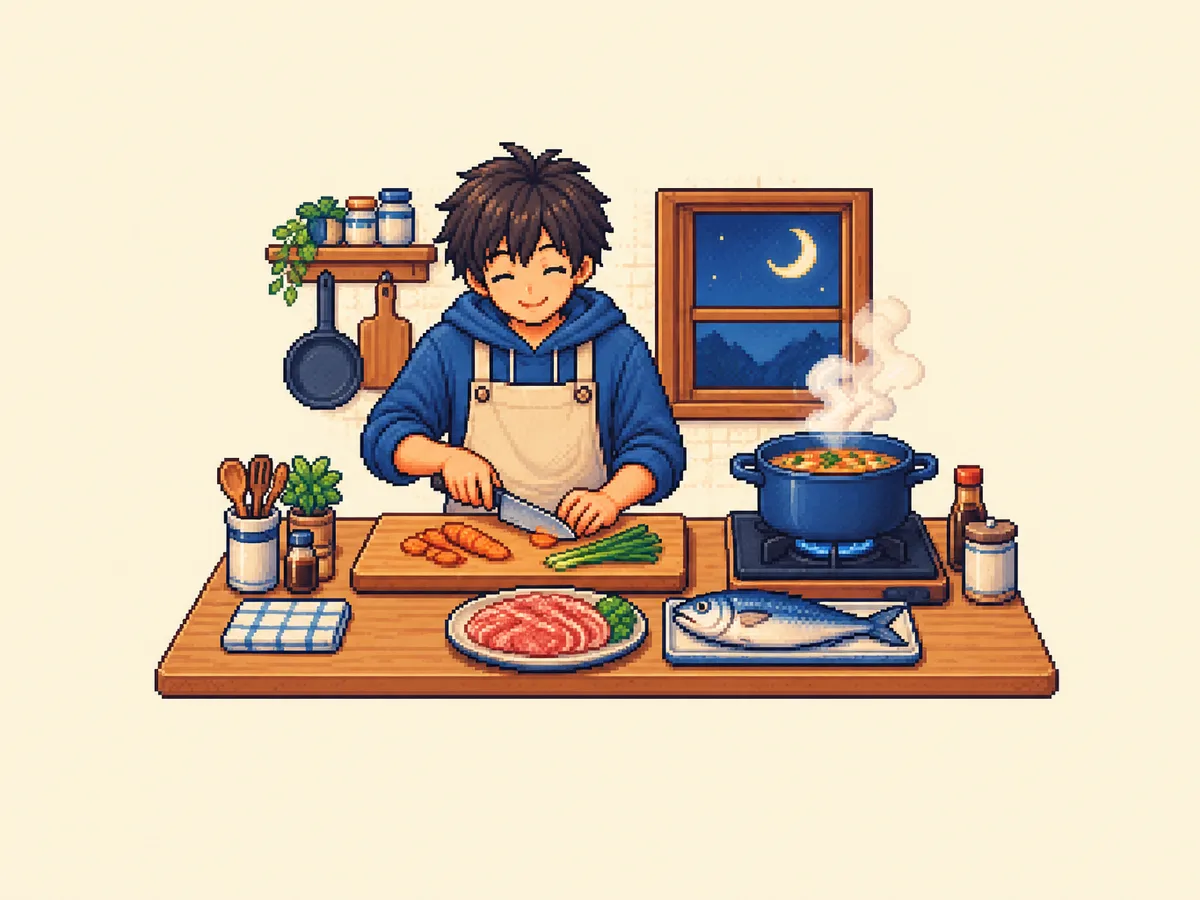
The first time I cooked dinner for my host family, I made spaghetti. I had all the words for the ingredients and none of the words for the steps. So when my host mother came into the kitchen to help, every instruction I gave her was a single noun and a gesture. "トマト." Chopping motion. "水." Pointing at the pot. She figured it out. The spaghetti was fine. But the next week she sat me down with a cookbook and taught me the て-form, because, as she put it, recipes are just て-forms all the way down.
She was right. This lesson covers the N5 words for dinner and the ingredients that go into it, the cooking verbs you need, and the て-form, which lets you chain steps together and ask people to do things.
This is Part 7 of the series. Part 6 covered lunch and invitations.
Dinner words
You met the first two in Part 1. Here they are with a few other evening words:
| Japanese | Reading | Meaning |
|---|---|---|
| 晩ご飯 | bangohan | dinner |
| 夕飯 | yūhan | dinner, evening meal |
| 料理 | ryōri | cooking, cuisine, a dish |
| 家族 | kazoku | family |
| みんな | minna | everyone |
料理 is a flexible word. It can mean the act of cooking (料理をします, ryōri o shimasu, I cook), a single dish (この料理, kono ryōri, this dish), or a whole cuisine (日本料理, nihon ryōri, Japanese food). When you see 料理 on a sign, it usually means the restaurant serves a particular type of food: 中華料理 (chūka ryōri) is Chinese food, イタリア料理 (itaria ryōri) is Italian.
Meat, fish, and vegetables
| Japanese | Reading | Meaning |
|---|---|---|
| 肉 | niku | meat |
| 牛肉 | gyūniku | beef |
| 豚肉 | butaniku | pork |
| とり肉 | toriniku | chicken |
| 魚 | sakana | fish |
| 野菜 | yasai | vegetables |
| 卵 | tamago | egg |
| ご飯 | gohan | rice |
| お酒 | osake | alcohol, sake |
The meat words follow a pattern you'll love. 肉 (niku) means meat. Put an animal in front of it and you get that animal's meat:
- 牛 (ushi/gyū, cow) + 肉 = 牛肉 (gyūniku), beef
- 豚 (buta, pig) + 肉 = 豚肉 (butaniku), pork
- 鳥 (tori, bird) + 肉 = とり肉 (toriniku), chicken
The N5 list spells chicken as とり肉, half in hiragana. You'll also see it as 鶏肉 (with a harder kanji for chicken) or 鳥肉 on packaging. They're all the same word.
You might notice 牛 is read gyū here but ushi on its own. Same kanji, different reading, because 牛肉 is a Chinese-style compound. You already know this reading from 牛乳 (gyūnyū, milk) in Part 3. Once you've seen it twice, it sticks.
お酒 (osake) means alcohol in general, not just rice wine. When someone asks お酒を飲みますか, they're asking whether you drink, period. Rice wine specifically is 日本酒 (nihonshu).
Cooking verbs
These N5 verbs cover most of what happens in a kitchen.
| Dictionary form | ます form | Meaning |
|---|---|---|
| 作る (tsukuru) | 作ります | to make |
| 洗う (arau) | 洗います | to wash |
| 切る (kiru) | 切ります | to cut |
| 入れる (ireru) | 入れます | to put in |
| 出す (dasu) | 出します | to take out, to serve |
| 使う (tsukau) | 使います | to use |
| 並べる (naraberu) | 並べます | to line up, to set (the table) |
| 待つ (matsu) | 待ちます | to wait |
作る is the everyday verb for cooking a meal. 晩ご飯を作ります (bangohan o tsukurimasu) is "I make dinner." You can also say 料理をします.
並べる literally means "to line things up." In the kitchen it's what you do with plates and dishes when setting the table: お皿を並べます (osara o narabemasu).
Grammar: the て-form
The て-form is a verb form that ends in て or で. On its own it doesn't have a tense. Its job is to connect a verb to something else. At N5, it does two big jobs: chaining actions together and making requests.
Making the て-form
Here's the honest truth: the て-form has rules, and you have to learn them. The good news is they're consistent, and you only need to learn them once.
Group 2 verbs (る-verbs, ending in いる or える): drop る, add て.
- 食べる → 食べて (tabete)
- 入れる → 入れて (irete)
- 並べる → 並べて (narabete)
Group 1 verbs (う-verbs): the ending changes depending on the last syllable.
| Ending | Becomes | Example |
|---|---|---|
| う, つ, る | って | 洗う → 洗って, 待つ → 待って, 作る → 作って, 切る → 切って |
| む, ぶ, ぬ | んで | 飲む → 飲んで |
| く | いて | 置く → 置いて |
| ぐ | いで | 泳ぐ → 泳いで |
| す | して | 出す → 出して |
Irregular て-forms:
- する → して (shite)
- 来る → 来て (kite)
- 行く → 行って (itte). It ends in く, but it breaks the rule. Not 行いて.
Watch out for 切る. It ends in いる, so it looks like a Group 2 verb, but it's Group 1. That makes it 切って (kitte), not 切て. 入る (hairu, to enter) and 帰る (kaeru, to go home) are the same kind of trap. There's no shortcut here. You learn these few as exceptions.
Job 1: chaining steps
Connect actions in order with the て-form. Only the last verb carries the tense.
野菜を洗って、切ります。 (Yasai o aratte, kirimasu.) I wash the vegetables and cut them.
肉を切って、なべに入れて、三十分待ちます。 (Niku o kitte, nabe ni irete, sanjuppun machimasu.) Cut the meat, put it in the pot, and wait thirty minutes.
なべ (nabe) is a cooking pot. It's not N5, but you'll see it a lot: it's also the name of a whole category of winter hot-pot dishes.
That's how recipes are written. Every step is a て-form until the last one. Read a Japanese recipe out loud and you'll hear it: て, て, て, ます.
The past tense works the same way. Put the past on the last verb only:
晩ご飯を作って、食べました。 (Bangohan o tsukutte, tabemashita.) I made dinner and ate it.
Job 2: asking someone to do something
In Part 2 you used ください after a noun: 水をください, water please. Put ください after a て-form and it means "please do this."
野菜を洗ってください。 (Yasai o aratte kudasai.) Please wash the vegetables.
ちょっと待ってください。 (Chotto matte kudasai.) Please wait a moment.
お皿を並べてください。 (Osara o narabete kudasai.) Please set out the plates.
This is one of the most useful patterns in Japanese, in and out of the kitchen. Teachers, signs, and staff use it constantly. 見てください (mite kudasai, please look), 座ってください (suwatte kudasai, please sit down), 食べてください (tabete kudasai, please eat).
A dinner conversation
Here's a short exchange using only words and grammar from this series.
| Speaker | Japanese | Meaning |
|---|---|---|
| A | 今晩、何を作りますか。 | What are you making tonight? |
| B | カレーを作ります。 | I'm making curry. |
| A | 肉は何を使いますか。 | What meat are you using? |
| B | 豚肉です。野菜を洗ってください。 | Pork. Please wash the vegetables. |
| A | はい。それから、切りますか。 | Okay. Then should I cut them? |
| B | ええ、切って、なべに入れてください。 | Yes, cut them and put them in the pot. |
それから (sore kara), "after that, and then," is on the N5 list and pairs perfectly with recipe steps.
More words from this lesson
Every other word that came up in this lesson, in one place. Everything from なべ down isn't on the N5 list.
| Japanese | Reading | Meaning |
|---|---|---|
| それから | sore kara | after that, and then |
| する | suru | to do (料理をする, to cook) |
| 置く | oku | to put, to place |
| なべ | nabe | cooking pot; hot-pot dish |
| 鶏肉 | toriniku | chicken (common packaging spelling) |
| 日本酒 | nihonshu | sake, rice wine |
| 日本料理 | nihon ryōri | Japanese food |
| 中華料理 | chūka ryōri | Chinese food |
| イタリア料理 | itaria ryōri | Italian food |
Practice exercises
Tap each one to check.
Make the て-form
食べる
食べて (tabete). Group 2: drop る, add て.飲む
飲んで (nonde). む becomes んで.洗う
洗って (aratte). う becomes って.出す
出して (dashite). す becomes して.切る
切って (kitte). Trick question: 切る is Group 1 even though it ends in いる.行く
行って (itte). The one irregular く verb.
Chain the steps
Wash the fish. Cut the fish. (one sentence)
魚を洗って、切ります。 (Sakana o aratte, kirimasu.)I made dinner and drank sake.
晩ご飯を作って、お酒を飲みました。 (Bangohan o tsukutte, osake o nomimashita.) Only the last verb takes the past tense.
Make a request
Please cut the meat.
肉を切ってください。 (Niku o kitte kudasai.)Please wait.
待ってください。 (Matte kudasai.)Please put the eggs in the fridge.
卵を冷蔵庫に入れてください。 (Tamago o reizōko ni irete kudasai.)
Vocabulary check
What do you get with 豚 + 肉?
豚肉 (butaniku), pork.Someone asks お酒を飲みますか. What are they asking?
Whether you drink alcohol in general, not just sake.
Where to go from here
The series wraps up with Part 8: Japanese Desserts and Snacks, covering sweets, fruit, and how to say what you like and what you want. If the て-form rules feel like a lot, that's normal. Come back to this lesson's exercises in a few days. They stick better on the second pass than the first.