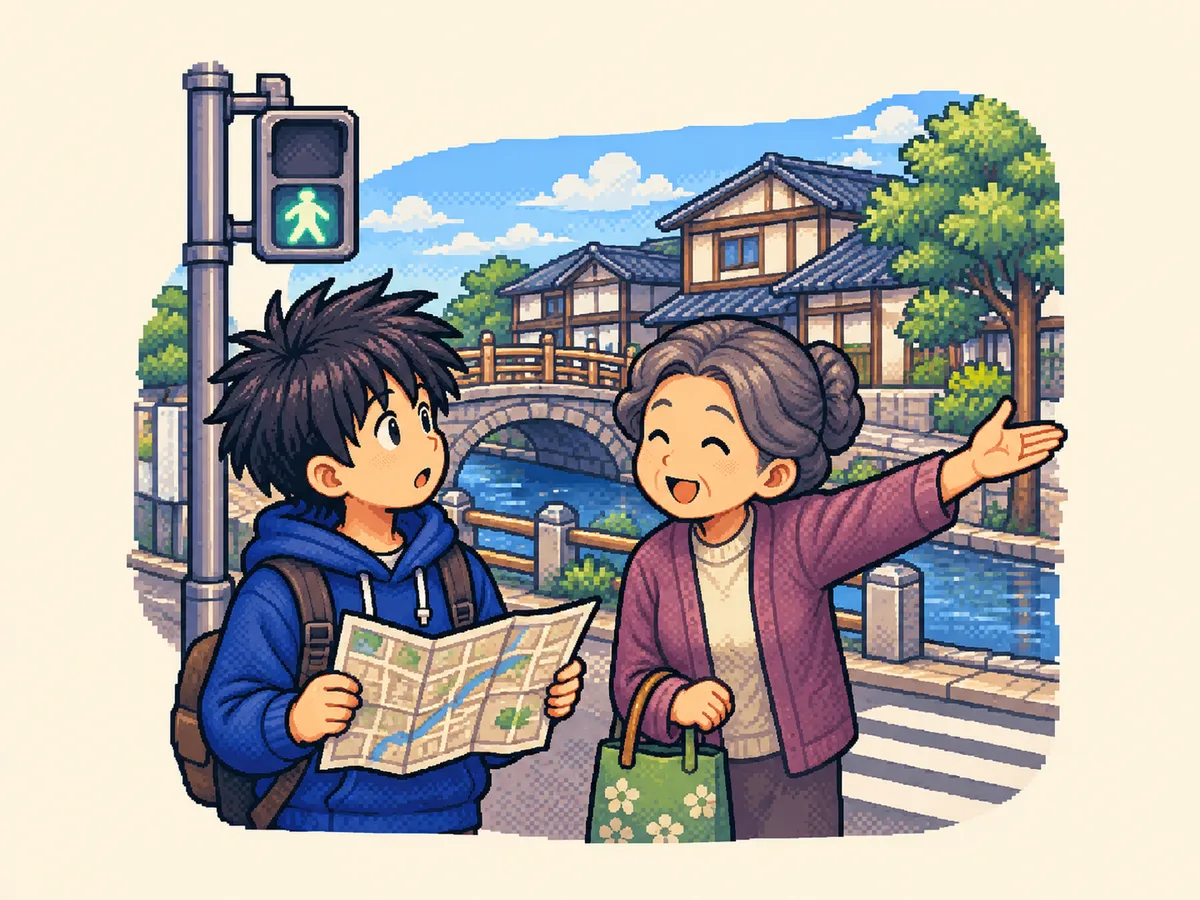
The guesthouse was supposed to be a seven-minute walk from Kurashiki Station. My phone died somewhere between the platform and the exit, so I did what Part 1 of this series tells you to do. I found someone to ask. A woman with a shopping bag stopped, listened to the name of the guesthouse, and gave me directions in one long, friendly sentence:
まっすぐ行って、二つ目の信号を右に曲がって、橋を渡って、左側です。
I caught まっすぐ, straight. I caught 右 (right), 橋 (bridge), and 左 (left). I thanked her, walked straight, and turned right at the first traffic light. There was a bridge. I crossed it and looked left. A parking lot.
Kurashiki is a canal town. It has a lot of bridges.
The word I'd missed was 二つ目, "the second one." Four syllables in the middle of the sentence, and they were the whole point. I walked back toward the station, found a 交番, and the officer inside drew the route on a notepad, tapping each traffic light with a pen and counting out loud: ひとつ、ふたつ.
That's the hard part of directions in any language. Asking is easy. The answer comes back as a chain: a landmark, a turn, another landmark, another turn. Japanese joins the links with one verb form, and once you can hear where each link starts and ends, you can follow the whole thing.
This is Part 5 of the Japanese for Travel series. Part 1 got you to the right station exit, and Part 4 got you there on time. Now you're outside, on foot, and the place you want isn't in sight.
Asking the way
Part 1's question still works. トイレはどこですか。 If the place is close enough to point at, that's all you need, and the answer will be あそこです and an open hand.
When the place is a few streets away, two other questions work better.
Is there one around here?
When you don't need a particular place, just the nearest one of something:
この辺にコンビニはありますか。 (Kono hen ni konbini wa arimasu ka.) Is there a convenience store around here?
- この辺 (kono hen) means "this area." 辺 (hen) is "area," and この is "this," the same この as in これ.
- ありますか (arimasu ka) asks "is there?" The verb is ある (aru) , "to exist," used for things that don't move on their own.
Swap in any place from Part 1. この辺に銀行はありますか。 この辺にトイレはありますか。 The answer will often skip the verb and go straight to where it is: あそこです, or 駅の前です.
I'm trying to get to...
For a specific place, use this:
美術館に行きたいんですが。 (Bijutsukan ni ikitai n desu ga.) I'm trying to get to the art museum...
- 美術館 (bijutsukan) is "art museum."
- に marks where you're headed. It's the に from 京都に着きます in Part 4.
- 行きたい (ikitai) is "want to go." Take 行きます, drop the ます, and add たい.
- んですが (n desu ga) softens the sentence and leaves it hanging. The meaning is something like "...and I was hoping you could help." You don't have to say the second half. The trailing が says it for you.
This is the version I use most now, because it works perfectly with a phone. Open the map, point at the pin, and say:
ここに行きたいんですが。 (Koko ni ikitai n desu ga.) I'm trying to get here...
Nobody has to guess what you're saying, and you never have to pronounce the name of the place. If my phone had been alive in Kurashiki, this is what I would have said.
When you're already lost
道に迷いました。 (Michi ni mayoimashita.) I'm lost.
道 (michi) is "road" or "way," and 迷う (mayou) is "to lose your way." It's a good opener at a 交番, because it tells the officer exactly what kind of help you need.
Right, left, and straight ahead
| Japanese | Reading | Meaning |
|---|---|---|
| 右 | migi | right |
| 左 | hidari | left |
| まっすぐ | massugu | straight ahead |
| 右側 | migigawa | the right side |
| 左側 | hidarigawa | the left side |
| 反対側 | hantaigawa | the other side (of the street) |
右 and 左 look alike, and I mixed them up for months. The difference is the bottom part. 右 has 口, the "mouth" from 入口 and 出口 in Part 1. 左 has 工. My trick: the right hand is the one most people eat with, so 右 is the one with the mouth.
側 (gawa) means "side." Put it after 右 or 左 and you get the side of the street something is on, which is how most directions end. 反対 means "opposite," so 反対側 is the far side of the road. If someone says 道の反対側です, you're going to have to cross.
まっすぐ is the word you'll hear most. It's almost always followed by 行って, "go, and then...," which we'll get to in a minute.
Japanese directions run on landmarks
Here's something that surprised me on my first trip. Most streets in Japan don't have names. Addresses work by numbered districts and blocks, not by street, so nobody will tell you to turn onto Maple Avenue. Big roads have names, and Kyoto has its own grid system, but the side streets you'll actually be walking down mostly don't.
So directions run on landmarks. You'll be told to turn at a corner, at a traffic light, or at a convenience store.
| Japanese | Reading | Meaning | Notes |
|---|---|---|---|
| 道 | michi | road, street | Also "the way" to somewhere |
| 角 | kado | corner | Of a street or a building |
| 信号 | shingō | traffic light | Not on the N5 list, but you'll hear it constantly |
| 交差点 | kōsaten | intersection | Usually a big one, with lights |
| 横断歩道 | ōdan hodō | pedestrian crossing | The striped kind |
| 橋 | hashi | bridge | Same sound as 箸, chopsticks, with a different pitch |
| 突き当たり | tsukiatari | the end of the street | Where you can't go straight any more |
| 建物 | tatemono | building | |
| ビル | biru | building | An office or shop building, from English "building" |
| 公園 | kōen | park |
Add these to the places from Part 1 (駅, 銀行, コンビニ, 交番) and you have nearly every landmark you'll hear.
突き当たり is worth learning even though it's long. It's the point where the road you're on ends at another road, usually a T-junction. 突き当たりを右 means "at the end of the street, go right." English needs a whole phrase for it. Japanese has one word.
Green means 青
A green traffic light in Japan is a 青信号 (ao shingō), and 青 (ao) usually means blue. Older Japanese used 青 for a range of blues and greens, and the word stuck to traffic lights. Many Japanese lights are even a noticeably bluish green. If someone tells you to cross when it's 青, they mean green.
Before, past, and across
Three more position words, to go with 前, 隣, and 向こう from Part 1. These are the ones that come up when someone describes exactly where along the street a place is.
| Japanese | Reading | Meaning | Example |
|---|---|---|---|
| 手前 | temae | just before, this side of | 橋の手前 just before the bridge |
| 先 | saki | past, beyond | 橋の先 past the bridge |
| 向かい | mukai | across from, facing | 駅の向かい across from the station |
手前 and 先 are a pair, and they're easy to swap. 手前 is the near side of the landmark, before you reach it. 先 is the far side, after you've passed it. 橋の手前 means don't cross the bridge. 橋の先 means cross it and keep going.
向かい is directly opposite, facing it. 向こう from Part 1 is looser, more like "over on the other side." For a shop across the street, you'll hear both.
Counting landmarks: 一つ目, 二つ目
Here's the word that sent me to a parking lot. To say "the first," "the second," and so on, Japanese takes the counting words 一つ, 二つ, 三つ and adds 目 (me):
| Japanese | Reading | Meaning |
|---|---|---|
| 一つ目 | hitotsume | the first |
| 二つ目 | futatsume | the second |
| 三つ目 | mittsume | the third |
If you did Ordering Food in Japanese, these are the ひとつ and ふたつ you ordered with. Then の connects the number to the landmark:
二つ目の信号 (futatsume no shingō) the second traffic light
一つ目の角 (hitotsume no kado) the first corner
You'll also hear 次の (tsugi no), the "next" from Part 2. 次の角 is the next corner you come to, which is the same as 一つ目の角.
When you hear 目 after a number, slow down and count. It's the one detail in a set of directions that guessing won't fix.
Three verbs, and one for passing things
Directions use a small set of verbs, and you can get almost anywhere with these:
| Japanese | Reading | Meaning |
|---|---|---|
| 行く | iku | to go |
| 曲がる | magaru | to turn |
| 渡る | wataru | to cross (a road, a bridge) |
| 過ぎる | sugiru | to go past |
The grammar point: を for the route, に for the direction
Every step in a set of directions has the same three pieces: a place, a direction, and a verb. Two particles hold them together.
に marks the direction you turn. 右に曲がる, turn right. 左に曲がる, turn left.
を marks the place you move along, through, or across. This is the one that surprises English speakers. In English you turn at a corner and walk along a road. Japanese treats the corner and the road as the thing your movement goes through, so they take を:
- 角を曲がる (kado o magaru) : turn at the corner
- 橋を渡る (hashi o wataru) : cross the bridge
- この道をまっすぐ行く (kono michi o massugu iku) : go straight along this road
- コンビニを過ぎる (konbini o sugiru) : go past the convenience store
Put both particles in one sentence and you get the step I needed in Kurashiki:
二つ目の信号を右に曲がります。 (Futatsume no shingō o migi ni magarimasu.) You turn right at the second traffic light.
The order is place を, direction に, verb. The landmark comes first. That's useful, because by the time you hear 右 or 左, you already know where you're turning. It also means that if you miss the landmark, you've missed the most important part. Which is exactly what I did.
You've seen both particles doing other jobs. In the Food series, を marked the thing you ate or ordered. In Part 2, に marked the train you got on. Here を marks a path. Same particle, different job, and a few examples are all it takes before 角を曲がる sounds right.
Following a chain of directions
Nobody gives directions one sentence at a time. They chain the steps together, and the link is the て-form, the verb form that ends in て or で. Each て means "do this, and then..." Only the last verb finishes the sentence.
You don't need to know how to make every て-form for this. Japanese Dinner and Cooking Words has the full rules if you want them. For directions, you need to recognize four:
| ます form | て-form | Reading | Meaning |
|---|---|---|---|
| 行きます | 行って | itte | go, and... |
| 曲がります | 曲がって | magatte | turn, and... |
| 渡ります | 渡って | watatte | cross, and... |
| 過ぎます | 過ぎて | sugite | go past, and... |
行って is irregular. By the normal rule, 行く would become 行いて, the way 書く becomes 書いて. It doesn't. It's 行って, every time.
Here's the sentence from the start of this lesson, split into links:
| Link | Reading | Meaning |
|---|---|---|
| まっすぐ行って、 | massugu itte | go straight, and |
| 二つ目の信号を右に曲がって、 | futatsume no shingō o migi ni magatte | turn right at the second light, and |
| 橋を渡って、 | hashi o watatte | cross the bridge, and |
| 左側です。 | hidarigawa desu | it's on the left. |
And all together, at the speed you'll actually hear it:
まっすぐ行って、二つ目の信号を右に曲がって、橋を渡って、左側です。
Every link ends in て. When you hear て, one step is over and the next one is starting. When you hear です or ます, you've arrived. Listen for the landmark at the start of each link, and the direction just before the verb.
てください: the same directions, as instructions
Staff and police officers often put ください on the last verb. That turns the step into a polite instruction:
この道をまっすぐ行ってください。 (Kono michi o massugu itte kudasai.) Please go straight along this road.
The directions are the same. The extra word is politeness, so don't let it throw you.
The last link: where to look
The end of the chain tells you where the place is once you get there. You'll hear one of these:
- 左側です。 (Hidarigawa desu.) It's on the left.
- 左側にあります。 (Hidarigawa ni arimasu.) It's on the left. This is ある again, from この辺に〜はありますか.
- 右側に見えます。 (Migigawa ni miemasu.) You'll see it on the right. 見える (mieru) means "to be visible."
For your purposes, all three mean the same thing. Start looking.
Is it far?
Before you set off, find out whether it's a walk at all.
遠いですか。 (Tōi desu ka.) Is it far?
- 遠い (tōi) : far
- 近い (chikai) : close. It's related to 近く, "nearby," from Part 1.
For an actual number, take the question from Part 4 and put one word in front:
歩いてどのくらいかかりますか。 (Aruite donokurai kakarimasu ka.) How long does it take on foot?
歩いて (aruite) is the て-form of 歩く (aruku) , "to walk." Here it means "by walking." The answer uses the minutes from Part 4:
歩いて十分ぐらいです。 (Aruite juppun gurai desu.) About ten minutes on foot.
That's the squeezed juppun, not jūfun. If the answer is bad news, it will usually start with ちょっと, the softener from Part 1:
ちょっと遠いですね。バスがいいですよ。 (Chotto tōi desu ne. Basu ga ii desu yo.) It's a bit far. The bus would be better.
がいいです is how people recommend something, the same いい as in 何時ごろがいいですか from Part 4. The よ on the end is a friendly heads-up: "just so you know."
Keeping up with the answer
Directions come fast, and the person giving them is trying to help you, not test you. Three moves let you slow the exchange down to your speed.
もう一度お願いします。 (Mō ichido onegai shimasu.) One more time, please.
ゆっくりお願いします。 (Yukkuri onegai shimasu.) Slowly, please.
もう一度 (mō ichido) is "once more," and ゆっくり (yukkuri) is "slowly." Both work with お願いします, the all-purpose "please" from Part 3.
The third move is the habit from Part 4: say it back with ですね. With directions, do it one link at a time, as you hear them.
二つ目の信号ですね。 (Futatsume no shingō desu ne.) The second light, right?
Saying the landmark back makes you notice which part you didn't catch. You can't repeat 二つ目 if you never heard it. If I had tried in Kurashiki, I would have stalled right there and asked again, while the woman was still standing in front of me.
They might just walk you there
It happens more often than you'd expect. You ask for directions, the person thinks about how to explain it, and then says:
一緒に行きましょうか。 (Issho ni ikimashō ka.) Shall I go with you?
一緒に (issho ni) means "together." Staff might say ご案内します (go-annai shimasu) , "I'll show you the way," from 案内 (annai) , "guidance."
It's a real offer, and people make it most when the place is close but hard to explain. If you'd like the help:
いいんですか。ありがとうございます。 (Ii n desu ka. Arigatō gozaimasu.) Are you sure? Thank you.
If you'd rather not take up their time, this is a polite no:
大丈夫です。ありがとうございます。 (Daijōbu desu. Arigatō gozaimasu.) I'll be fine. Thank you.
A full exchange, start to finish
Here's a traveler outside a station, phone in hand, stopping someone on the street. Everything in it comes from this lesson or the ones before it.
| Speaker | Japanese | Meaning |
|---|---|---|
| You | すみません。ここに行きたいんですが。 | Excuse me. I'm trying to get here... (showing the map) |
| Local | ああ、美術館ですね。 | Ah, the art museum. |
| You | 遠いですか。 | Is it far? |
| Local | いいえ、歩いて十分ぐらいです。 | No, about ten minutes on foot. |
| Local | この道をまっすぐ行って、二つ目の信号を右に曲がってください。 | Go straight along this road and turn right at the second traffic light. |
| You | 二つ目の信号ですね。 | The second light, right? |
| Local | はい。橋を渡って、左側にあります。 | Yes. Cross the bridge, and it's on the left. |
| You | 橋を渡って、左側ですね。 | Cross the bridge, on the left. |
| Local | はい、そうです。 | Yes, that's right. |
| You | ありがとうございます。 | Thank you. |
Notice that the traveler never says the name of the museum. The phone does that. And notice where the ですね checks go: one after the landmark, one after the last two links. Two short checks, and there's no parking lot at the end of this one.
Practice exercises
Tap each one to check. Say your answer out loud first.
Ask the way
Is there a convenience store around here?
この辺にコンビニはありますか。 (Kono hen ni konbini wa arimasu ka.)I'm trying to get here... (pointing at a map)
ここに行きたいんですが。 (Koko ni ikitai n desu ga.)Is it far?
遠いですか。 (Tōi desu ka.)How long does it take on foot?
歩いてどのくらいかかりますか。 (Aruite donokurai kakarimasu ka.)Slowly, please.
ゆっくりお願いします。 (Yukkuri onegai shimasu.)
Give the direction
Turn left at the corner.
角を左に曲がってください。 (Kado o hidari ni magatte kudasai.)Cross the bridge.
橋を渡ってください。 (Hashi o watatte kudasai.)Go straight along this road.
この道をまっすぐ行ってください。 (Kono michi o massugu itte kudasai.)Turn right at the third traffic light.
三つ目の信号を右に曲がってください。 (Mittsume no shingō o migi ni magatte kudasai.)
Follow the directions
一つ目の角を右に曲がってください。
Turn right at the first corner.コンビニを過ぎて、交差点を左に曲がってください。
Go past the convenience store, then turn left at the intersection.突き当たりを右に曲がってください。
At the end of the street, turn right.橋の手前を左に曲がってください。
Turn left just before the bridge. Don't cross it.銀行の向かいにあります。
It's across the street from the bank.
Understand what you hear
歩いて五分ぐらいです。
About five minutes on foot.ちょっと遠いですね。
It's a bit far. A bus or taxi suggestion usually comes next.右側に見えます。
You'll see it on the right.一緒に行きましょうか。
Shall I go with you? They're offering to walk you there.二つ目の信号の先です。
It's past the second traffic light.
Spot the mistake
角に右を曲がってください。
The particles are swapped. The corner takes を and the direction takes に: 角を右に曲がってください。橋に渡ってください。
The thing you cross takes を: 橋を渡ってください。行いてください。
行く is irregular. Its て-form is 行って: 行ってください。二の信号 (for "the second light")
Use the counting word plus 目: 二つ目の信号.歩いて十分 read as jūfun
It's juppun. じゅう and ふん squeeze into じゅっぷん.
Where to go from here
You can ask for a place you can't see, follow a chain of directions to the end, and find out whether it's worth walking. Part 6 of this series covers your hotel, from checking in to asking the front desk for what you need. It's coming next week. Until then, if the て-forms in this lesson went by fast, Japanese Dinner and Cooking Words shows how to build them for any verb. Go back to Part 1 for 前, 隣, and 向こう, or to Part 4 if 五分 and 十分 still trip you up. And the words you'll actually say in this lesson are mostly kana, so a few rounds of Hirakata flashcards will keep まっすぐ, コンビニ, and the small っ in 行って easy to read.