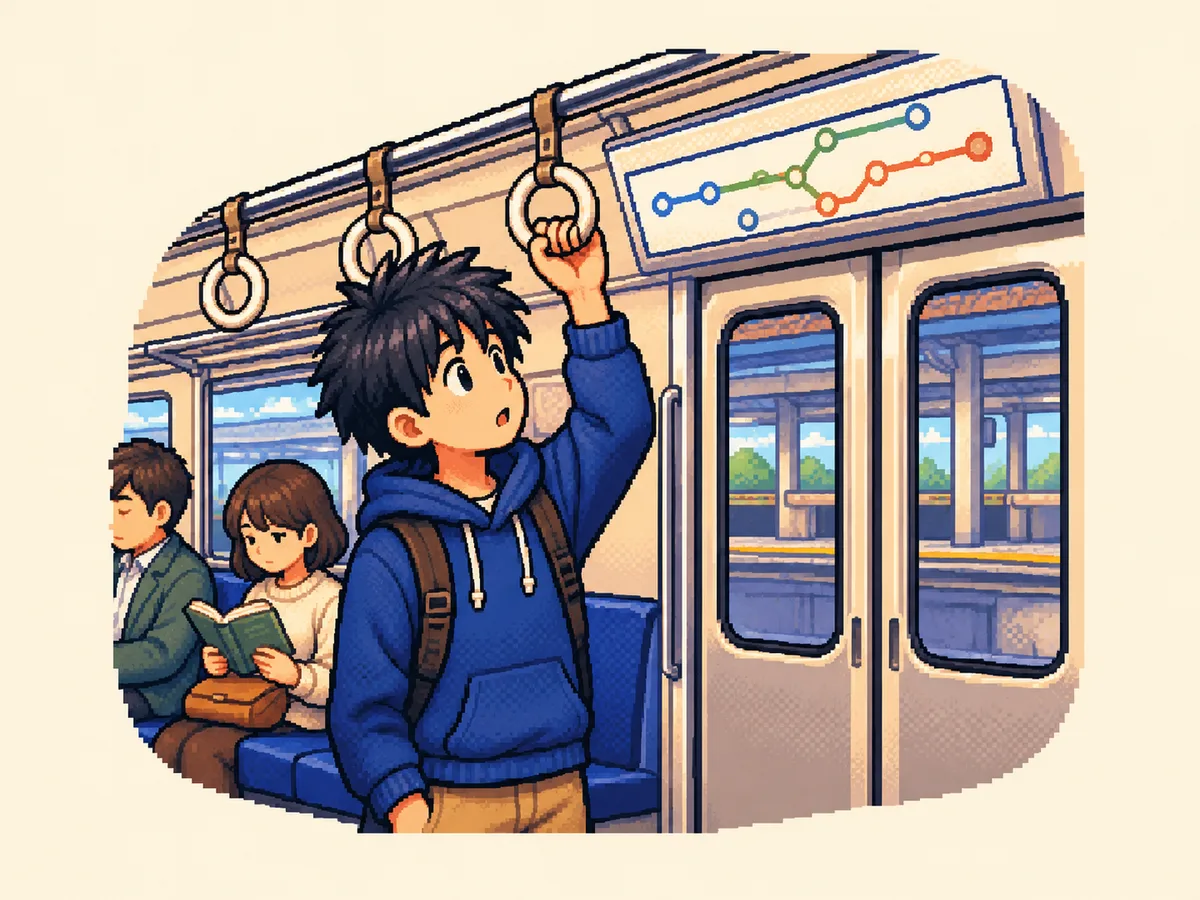
On my second day in Tokyo I wanted to go two stops. Just two. I found the right line, found the right platform, and got on the first train that pulled in. It was going the right direction. It was the right color. And it flew straight through my station without slowing down. Then it flew through the next one. By the time it stopped, I was twenty minutes past where I wanted to be.
The train wasn't wrong. I was. It was an express, and the sign on the front said so in two kanji I didn't know yet: 急行 (kyūkō). Everybody else on that platform read it at a glance and waited for the next one.
Japanese trains are fast, clean, and almost always on time. They are also very easy to ride wrong if you can't read three or four key words. This lesson covers those words: the verbs for getting on, getting off, and changing trains, the signs that tell you which train stops where, and the announcements that tell you when to move.
This is Part 2 of the Japanese for Travel series. Part 1 got you to the station with どこですか. Now we're going inside.
Three verbs that cover the whole trip
Almost every train sentence you'll need uses one of three verbs. Here they are in their polite ます form, which is the form you'll say out loud.
| Dictionary form | Reading | Polite form | Meaning |
|---|---|---|---|
| 乗る | noru | 乗ります (norimasu) | to get on, to ride |
| 降りる | oriru | 降ります (orimasu) | to get off |
| 乗り換える | norikaeru | 乗り換えます (norikaemasu) | to change trains, to transfer |
乗り換える is just 乗る plus 換える (kaeru, to swap). "Ride-swap." Once you see the 乗 in it, it's easy to spot on signs.
The grammar point: に for getting on, で for where
The verbs are easy. The particles are where people slip. Here's the rule:
[train] に 乗ります。 You get on into the train, so the train takes に.
電車に乗ります。 (Densha ni norimasu.) I get on the train.
[station] で 降ります。 The station is the place where the action happens, so it takes で.
渋谷で降ります。 (Shibuya de orimasu.) I get off at Shibuya.
[station] で [line] に 乗り換えます。 Changing combines both. で marks where you change, and に marks the line you change onto.
渋谷で銀座線に乗り換えます。 (Shibuya de Ginza-sen ni norikaemasu.) I change to the Ginza Line at Shibuya.
You'll also see 電車を降ります, with を. That を marks the thing you're leaving (the train), not the place. Both are correct. For a traveler, "station で" is the version you'll use most.
If に and で still blur together for you, here's the shortcut I used: に points at a target, で points at a stage. You get on to a train. Things happen on the stage of a station.
The words on the signs
These are the words you'll see on every station sign and map. Most are N5. ホーム is a katakana word from English "platform," so if you can read katakana, you can already read it.
| Japanese | Reading | Meaning | Notes |
|---|---|---|---|
| 電車 | densha | train | Literally "electric car" |
| 地下鉄 | chikatetsu | subway | "Under-ground iron" |
| 駅 | eki | station | From Part 1 |
| 線 | sen | line | 山手線 (Yamanote-sen), Yamanote Line |
| ホーム | hōmu | platform | Short for "platform" |
| 改札 | kaisatsu | ticket gates | Where you tap your card |
| 乗り換え | norikae | transfer | On signs pointing to other lines |
| 次 | tsugi | next | The next station or train |
| 〜行き | -yuki | bound for | 渋谷行き, bound for Shibuya |
| ドア | doa | door | |
| 席 | seki | seat |
乗り換え is the one I'd learn first. Inside a big station, the yellow or orange signs marked 乗り換え point to the other lines. Follow them and you'll never have to leave the gates to change trains.
〜行き is the second. Trains are labeled by where they end, not by where you're going. A train marked 渋谷行き (Shibuya-yuki) ends at Shibuya. If your stop is between here and Shibuya, that's your direction. Note that 行き is read yuki here, not iki, even though 行く is usually iku.
Platform numbers: 何番線
Platforms in Japan are numbered, and the number is followed by 番線 (bansen). 一番線 is Platform 1, 二番線 is Platform 2, and so on. The digits on the signs are usually plain Arabic numerals (1番線, 2番線), so you can match them by sight. You'll need the readings when someone tells you out loud.
| Sign | Reading | Meaning |
|---|---|---|
| 1番線 | ichibansen | Platform 1 |
| 2番線 | nibansen | Platform 2 |
| 3番線 | sanbansen | Platform 3 |
| 4番線 | yonbansen | Platform 4 |
| 何番線 | nanbansen | Which platform? |
Watch the 4. It's yon, not shi. Japanese avoids shi in a lot of counting because it sounds like 死 (shi, death). Platform 7 has the same issue: it's usually nanabansen, not shichibansen.
To ask which platform you need, put your destination in the Part 1 pattern and swap どこ for 何番線:
渋谷は何番線ですか。 (Shibuya wa nanbansen desu ka.) Which platform for Shibuya?
The answer will be short: 3番線です。 (Sanbansen desu.) Platform 3.
Train types: the lesson I learned the hard way
This is the section that would have saved me twenty minutes on day two. On many lines, several types of train share the same tracks and the same platforms. They go the same direction. They just stop at different stations.
The type is shown on the front of the train, on the side, and on the departure board, usually in a colored box. Here are the common ones, from slowest to fastest:
| Japanese | Reading | Meaning | Stops at |
|---|---|---|---|
| 普通 | futsū | local | Every station |
| 各駅停車 | kakueki teisha | local | Every station ("each-station stop") |
| 快速 | kaisoku | rapid | Skips some stations |
| 急行 | kyūkō | express | Skips more stations |
| 特急 | tokkyū | limited express | Only major stations |
普通 and 各駅停車 mean the same thing. Different train companies just pick different words. Both are safe: they stop everywhere.
The names aren't consistent across companies, either. On one line 快速 might skip two stations, and on another it might skip ten. So the honest rule is this: if your stop is a small station, take the 普通 or 各駅停車 unless you've checked. If your stop is a big one, the faster trains will probably stop there, and you can confirm with the question in the next section.
One more warning about 特急. On many lines it needs an extra ticket on top of the normal fare. If you get on without one, a conductor will usually just sell you the supplement on board, but it costs more than you planned. Part 3 of this series covers tickets.
The question that keeps you on the right train
If I could only teach one sentence from this lesson, it would be this one. You say it to a station worker, or to the person next to you on the platform, while pointing at the train:
この電車は渋谷に止まりますか。 (Kono densha wa Shibuya ni tomarimasu ka.) Does this train stop at Shibuya?
Here's how it breaks down:
- この (kono) means "this." It's the ko-so-a-do pattern from Part 1 again: この, その, あの, どの.
- 電車は sets "this train" as the topic.
- 渋谷に uses に again, pointing at the station as the place the train arrives.
- 止まります is the polite form of 止まる (tomaru) , "to stop."
- か makes it a question.
Swap in your own station and it works anywhere. The answer is almost always one of two:
はい、止まります。 (Hai, tomarimasu.) Yes, it stops there.
いいえ、止まりません。 (Iie, tomarimasen.) No, it doesn't.
Japanese answers to yes-or-no questions repeat the verb. You don't just get はい. You get はい plus the verb. That's good news for you, because 止まりません has a clear negative ending, ません, that you can catch even if the rest goes by fast.
Asking where to change
For trips that need a transfer, use どこ from Part 1 with で and 乗り換えます:
どこで乗り換えますか。 (Doko de norikaemasu ka.) Where do I change trains?
The answer will be a station name and です: 新宿です (Shinjuku desu). If you're lucky, they'll add the line too.
In practice, a map app will tell you where to change. But apps don't tell you which of the station's eight exits leads to the other line. That's when you follow the 乗り換え signs, and when they run out, you ask a staff member using the Part 1 pattern: 銀座線はどこですか。
What the announcements say
Every train in Japan announces the next station, usually in Japanese first and then English. In Tokyo the English is reliable. Outside the big cities, it often isn't there at all. These three lines cover most of what you'll hear:
次は、渋谷です。 (Tsugi wa, Shibuya desu.) The next station is Shibuya.
That's 次 (next) plus は plus the station name. On many lines they skip the です and just say the name twice: 次は渋谷、渋谷.
お出口は、左側です。 (Odeguchi wa, hidarigawa desu.) The exit is on the left side.
There's 出口 from Part 1, with a polite お on the front. 側 (gawa) means "side," so you'll hear 左側 (hidarigawa) for the left side or 右側 (migigawa) for the right. It's a small thing, but on a packed train it tells you which way to start squeezing.
ドアが閉まります。 (Doa ga shimarimasu.) The doors are closing.
閉まる (shimaru) means "to close." If you hear this and you're not on the train yet, wait for the next one. Japanese doors close on schedule, and pushing through them is the one thing station staff will definitely scold you for.
Getting off a crowded train
Rush hour trains in Tokyo are full in a way that's hard to picture until you're in one. If you're standing in the middle and your stop comes up, you need to get to the door, and nobody can see that you want to.
The phrase is two words you already know:
すみません、降ります。 (Sumimasen, orimasu.) Excuse me, I'm getting off.
Say it as you start moving, not after you've already pushed. People will turn sideways or step out onto the platform to let you through. Nobody minds. This is one of those phrases that sounds too simple to matter, and then you use it four times a day.
A few other habits that will make you look like you've done this before:
- Let people off first. Lines form at marked spots on the platform, on either side of where the doors will stop. You wait to the side until everyone is off.
- Keep your voice down. Trains are quiet. Phone calls on board are considered rude, and most people text instead.
- Backpacks go on your front or on the rack above the seats when it's crowded.
- Seats near the doors marked with a priority symbol are for elderly, pregnant, or injured passengers. Leave them free.
A full exchange, start to finish
Here's a traveler checking that they're on the right platform, then riding to their stop. Everything in it comes from this lesson or Part 1.
| Speaker | Japanese | Meaning |
|---|---|---|
| You | すみません。 | Excuse me. |
| Staff | はい。 | Yes? |
| You | この電車は渋谷に止まりますか。 | Does this train stop at Shibuya? |
| Staff | いいえ、止まりません。渋谷は3番線です。 | No, it doesn't. Shibuya is Platform 3. |
| You | 3番線ですか。 | Platform 3? |
| Staff | はい、あちらです。 | Yes, over that way. (open hand pointing) |
| You | ありがとうございます。 | Thank you. |
| Announcement | 次は、渋谷です。お出口は、左側です。 | The next station is Shibuya. The exit is on the left side. |
| You | すみません、降ります。 | Excuse me, I'm getting off. |
The platform number here is made up. Real stations number their platforms differently, so always check the signs. But the shape of the conversation is exactly what you'll get.
Practice exercises
Tap each one to check. Say your answer out loud first.
Build the sentence
I get on the train.
電車に乗ります。 (Densha ni norimasu.) The train takes に.I get off at Shinjuku.
新宿で降ります。 (Shinjuku de orimasu.) The station takes で.I change to the Ginza Line at Shibuya.
渋谷で銀座線に乗り換えます。 (Shibuya de Ginza-sen ni norikaemasu.)Does this train stop at Ueno?
この電車は上野に止まりますか。 (Kono densha wa Ueno ni tomarimasu ka.)Which platform for Shinagawa?
品川は何番線ですか。 (Shinagawa wa nanbansen desu ka.)
Read the sign
乗り換え
Transfer. Follow these signs to change lines.東京行き
Bound for Tokyo. 行き is read yuki here.各駅停車
Local train. It stops at every station.4番線
Platform 4. Read yonbansen, not shibansen.特急
Limited express. It only stops at major stations and may need an extra ticket.
Understand what you hear
いいえ、止まりません。
No, it doesn't stop there. Listen for the ません ending.次は、新宿です。
The next station is Shinjuku.お出口は、右側です。
The exit is on the right side.ドアが閉まります。
The doors are closing. Wait for the next train.
Spot the mistake
電車で乗ります。 (for "I get on the train")
The train should take に, not で: 電車に乗ります。 で would mean "by train," as in how you travel.渋谷に降ります。 (for "I get off at Shibuya")
Use で for the station where you get off: 渋谷で降ります。4番線 read as shibansen
It's yonbansen. Japanese usually avoids shi for 4 when counting.
Where to go from here
You can get on the right train, get off at the right stop, and change lines in between. Part 3 of this series covers buying tickets, from the fare machines to the bullet train counter. It's coming next week. Until then, go back to Part 1 if you want to drill どこですか and the station exit names, since you'll need both the moment you step off the train. If station names in kanji are slowing you down, start with the katakana ones on the signs (ホーム, ドア, and the English line names), and a few rounds of Hirakata katakana flashcards will get them reading at a glance.