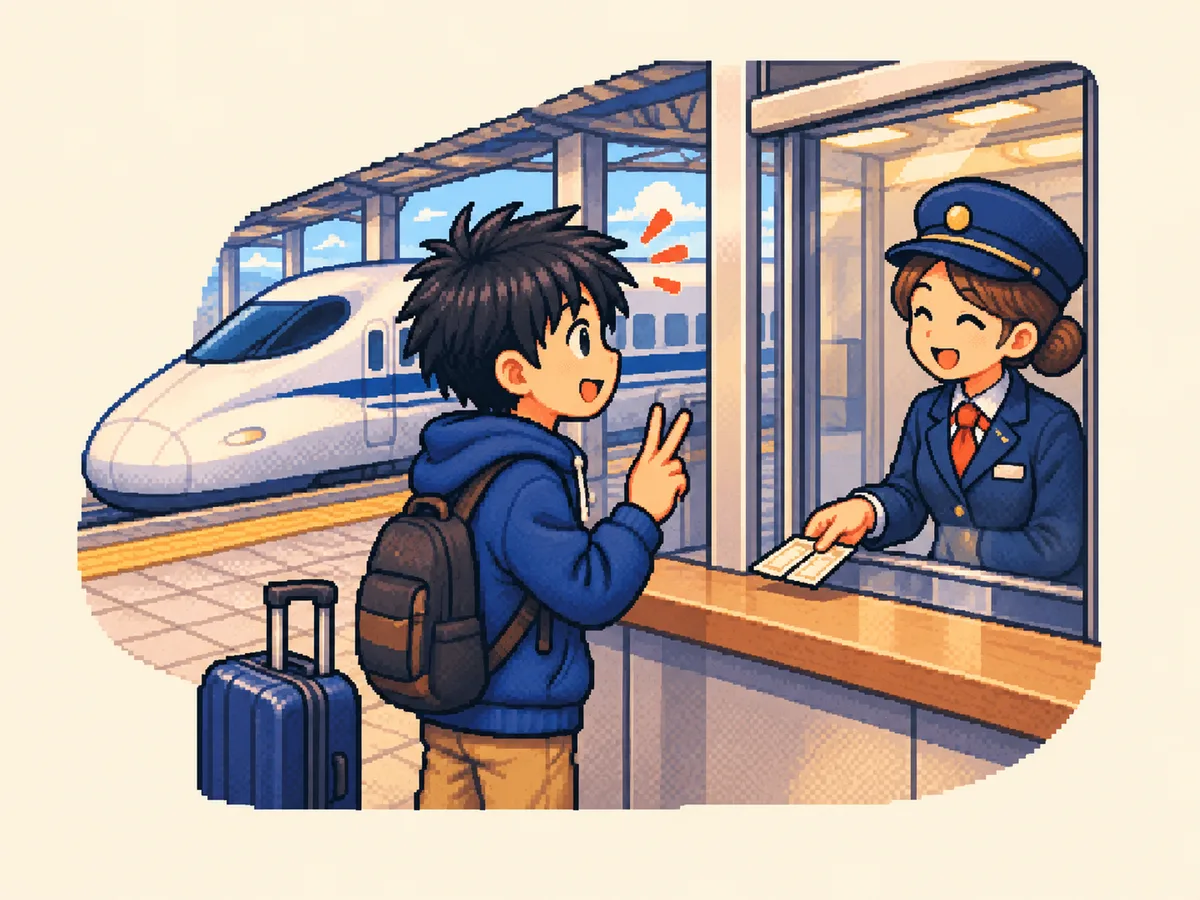
The first time I bought a bullet train ticket, I rehearsed my line the whole way to Tokyo Station. 京都まで、大人一枚。 (Kyōto made, otona ichimai.) One adult to Kyoto. I said it at the counter without a single mistake, and the clerk nodded. Then the clerk asked me something that ended in ですか, and I said はい.
The clerk smiled and asked again, a little slower. I said はい again, with more confidence. Then a laminated card came out from under the counter. The clerk pointed at two words on it and waited for me to point at one.
The question had been 指定席ですか、自由席ですか。 (Shiteiseki desu ka, jiyūseki desu ka.) Reserved seat or unreserved? There is no "yes" to that question. I'd prepared what I was going to say. I hadn't prepared for what came back.
That's what this lesson is about. Buying a ticket in Japan means reading a machine, saying where you're going and how many of you there are, and then answering a few quick questions you didn't plan for. None of it is hard once you've seen it.
This is Part 3 of the Japanese for Travel series. Part 2 got you on the right train. Now let's make sure you've paid for it.
Do you even need a ticket?
For most rides in a big city, honestly, no. Most of my train trips in Tokyo never involved a paper ticket. I used an ICカード (ai shī kādo) , a rechargeable card like Suica, PASMO, or ICOCA. You tap it on the 改札 (kaisatsu, ticket gates) from Part 2 on the way in, tap again on the way out, and the fare comes off automatically. The big-city cards work in each other's cities, so a Suica from Tokyo works fine in Osaka. You can buy one at the airport or a major station, and if you have an iPhone you can add one to Apple Wallet and skip the plastic.
So why learn ticket Japanese at all? Because there are three moments an IC card won't save you:
- Topping up and fixing fares. Your card runs low, the gate snaps shut, and you need to find the right machine.
- Smaller stations and rural lines. Some lines don't take IC cards. You buy a paper ticket from a machine, and the fare map above it may be in kanji only.
- Bullet trains and reserved seats. An IC card covers the basic fare. A 新幹線 (shinkansen) or a reserved seat needs a ticket on top of that.
We'll take them in that order.
The words on the ticket machine
Ticket machines are called 券売機 (kenbaiki). They stand in a row near the gates, under a sign that says 切符売り場 or きっぷうりば (kippu uriba), the ticket area. In any big station they have an English button, usually in a top corner of the touch screen. Press it. I'm not going to pretend otherwise.
But not every machine has one, the layout changes from company to company, and the same words show up on gates, signs, and receipts. These are the ones worth knowing.
| Japanese | Reading | Meaning | Notes |
|---|---|---|---|
| 切符 | kippu | ticket | Often written きっぷ |
| 券売機 | kenbaiki | ticket machine | "Ticket-sell-machine" |
| 切符売り場 | kippu uriba | ticket area | The sign above the machines |
| 大人 | otona | adult | |
| 子ども | kodomo | child | Some machines say 小児 instead |
| 小児 | shōni | child | Formal, mostly on machines |
| チャージ | chāji | top up | Add money to an IC card |
| 残高 | zandaka | balance | What's left on your card |
| 運賃 | unchin | fare | |
| 取消 | torikeshi | cancel | Your escape button |
| おつり | otsuri | change | Comes out at the bottom |
| 領収書 | ryōshūsho | receipt |
券 (ken) is the one character I'd take from this table. It means "ticket," and it turns up inside every kind of ticket word. You'll see it again at the bullet train counter.
小児 and 子ども mean the same thing. 小児 is a formal word you'll almost never hear out loud, but plenty of machines print it on the child button. Elementary-school-age children pay about half the adult fare.
Reading the fare map
Above the machines hangs a route map. Your station is marked, usually in red, and every other station has a number under its name. That number is the fare from where you're standing. Find your destination, read the number, and choose that amount on the machine.
At smaller stations this map is often Japanese only, which means reading two things: a station name in kanji, and a price. For the station name, keep your destination written in kanji on your phone and match it by shape. The price you can actually read.
The Food series lesson on ordering covers the basic number words: 百 (hyaku), 千 (sen), 万 (man), and 円 (en). On the map, fares are written in digits, like 180円, so you can read them by sight. You need the spoken readings when a clerk tells you the price.
The catch is that a few hundreds and thousands change their sound. These are the ones to watch:
| Number | Reading | Value | What changes |
|---|---|---|---|
| 三百 | sanbyaku | 300 | ひゃく becomes びゃく |
| 六百 | roppyaku | 600 | ろく and ひゃく squeeze into ろっぴゃく |
| 八百 | happyaku | 800 | はち and ひゃく squeeze into はっぴゃく |
| 三千 | sanzen | 3,000 | せん becomes ぜん |
| 八千 | hassen | 8,000 | はち and せん squeeze into はっせん |
Everything else is regular. A short city ride might cost 百八十円 (hyaku hachijū en) , and a longer one 三百八十円 (sanbyaku hachijū en) .
The cheapest-ticket trick
If you can't find your station on the map, don't stand there for five minutes like I did. Buy the cheapest ticket on the machine and get on the train. When you arrive, you pay the difference. Japanese rail is built for this, and nobody will think twice about it.
Which brings us to the most useful machine in the station.
When the gate says no: 精算機
Sooner or later, a gate will slam its little doors in front of you and beep. It sounds like an alarm. It isn't. It means your ticket or card doesn't cover the trip yet. Either your IC card balance is too low, or your paper ticket was for a shorter ride.
Step back and look along the row of gates, on the inside. There will be a machine labeled 乗り越し精算機 (norikoshi seisanki) , or just 精算機 (seisanki) .
乗り越し is 乗る from Part 2 plus 越す (kosu), "to go past." You rode past what you paid for. 精算 (seisan) means "settling up."
Put your ticket or card in, and the screen shows what you owe. With an IC card, you チャージ the difference right there and walk out. With a paper ticket, you pay and get a new ticket, called a 精算券 (seisanken), that opens the gate.
If there's no machine, or it won't take what you're feeding it, go to the staffed window at the end of the row of gates. Hold up your ticket or card and say:
すみません、精算お願いします。 (Sumimasen, seisan onegai shimasu.) Excuse me, I need to pay the difference.
You don't need to explain where you got on. The station you started from is on the ticket or the card.
The grammar point: まで, and counting tickets with 枚
At a staffed counter, everything comes down to one sentence: where you're going, and how many tickets. That takes two small pieces.
まで: "as far as"
まで (made) means "until" or "as far as." It goes after your destination. Its partner is から (kara), "from":
東京から京都まで (Tōkyō kara Kyōto made) from Tokyo to Kyoto
At a counter you rarely need から, because you're standing at the start. Put まで together with いくら from the Food series and you can ask any fare:
京都まで、いくらですか。 (Kyōto made, ikura desu ka.) How much is it to Kyoto?
Why まで and not に? In Part 2, に pointed at a place you arrive at, like 渋谷に止まります. まで says how far something reaches. A ticket is paid by distance, so まで is the natural fit.
枚: the counter for tickets
In the Food series you counted things with ひとつ, ふたつ. Those work for almost anything. But Japanese also has counters for particular kinds of things, and flat things like tickets, paper, stamps, and shirts use 枚 (mai).
| Japanese | Reading | Meaning |
|---|---|---|
| 一枚 | ichimai | one (ticket) |
| 二枚 | nimai | two |
| 三枚 | sanmai | three |
| 四枚 | yonmai | four |
| 何枚 | nanmai | how many? |
Look at the 4 again. It's yon, just like 4番線 (yonbansen) in Part 2. When counting, Japanese steers around shi almost everywhere.
Putting it together
Here's the full sentence, for two people this time:
京都まで、大人二枚お願いします。 (Kyōto made, otona nimai onegai shimasu.) Two adult tickets to Kyoto, please.
Compare it to コーヒーを二つください from the Food series and something's missing. The full version would be 大人の切符を二枚お願いします, "two adult tickets, please." But at a ticket counter, nobody says 切符. It's obvious. So the sentence shrinks to 大人 (what kind) plus 二枚 (how many). Clerks talk the same way, so expect to hear it back.
For a mixed group, join the parts with と, the same と you used to order two different dishes:
大人二枚と子ども一枚 (otona nimai to kodomo ichimai) two adults and one child
And if 枚 won't come to you in the moment, 二つ will still be understood. It'll just sound like you're ordering coffee.
The bullet train counter: みどりの窓口
For the 新幹線 and other long-distance trains, JR's staffed ticket office is the みどりの窓口 (midori no madoguchi) , "the green window." 緑 (midori) is green, and 窓口 (madoguchi) is a service counter, from 窓 (mado) , window. Look for the green sign.
Some stations have cut back on staffed counters and put in reserved-seat ticket machines, 指定席券売機 (shiteiseki kenbaiki), which have English menus. Plenty of travelers also book online. But when the trip is complicated, or the machine won't do what you want, the counter is where a person sorts it out.
Two tickets for one ride
Remember the 特急 warning in Part 2? Here's how that works. A bullet train or limited express fare comes in two parts:
- 乗車券 (jōshaken) : the basic fare ticket, for the distance.
- 特急券 (tokkyūken) : the express ticket, for the speed and the seat.
There's 券 again. Sometimes both are printed on one ticket, and sometimes you get two. If you get two, stack them and feed them into the gate together. The gate reads both and hands both back. Feed in only one and the doors stay shut, which I can confirm from experience.
Seat and ticket words
| Japanese | Reading | Meaning | Notes |
|---|---|---|---|
| 新幹線 | shinkansen | bullet train | "New trunk line" |
| 指定席 | shiteiseki | reserved seat | Your own numbered seat |
| 自由席 | jiyūseki | non-reserved seat | Cheaper, first come first served |
| グリーン車 | gurīnsha | Green Car | First class |
| 片道 | katamichi | one way | |
| 往復 | ōfuku | round trip | |
| 窓側 | madogawa | window side | |
| 通路側 | tsūrogawa | aisle side |
窓側 and 通路側 use 側 (gawa, side), the word from the Part 2 announcements (左側, 右側). Window plus side is "window side." Aisle plus side is "aisle side." No new grammar at all.
自由席 is cheaper, and you sit wherever there's space in the few cars set aside for it. On a quiet weekday that's fine. Before a holiday weekend, you might stand the whole way. If the trip matters, pay for 指定席.
One tip I learned too late: if you're riding from Tokyo toward Kyoto or Osaka, the window seat on the E side faces Mount Fuji. Ask for 窓側, and if the clerk shows you a seat map, point at E.
Answering an either-or question
Back to my はい problem. The questions at a ticket counter mostly come in one shape: two choices, each ending in ですか.
片道ですか、往復ですか。 (Katamichi desu ka, ōfuku desu ka.) One way or round trip?
In English you'd hear the word "or." Japanese doesn't need one. It's just two questions in a row, and the second ですか is your cue that you're being offered a choice. はい doesn't answer it. You answer by picking one.
The simplest way is to repeat your choice with です:
片道です。 (Katamichi desu.) One way.
The way you'll hear most often is your choice plus でお願いします:
指定席でお願いします。 (Shiteiseki de onegai shimasu.) A reserved seat, please.
That で marks the option you're choosing, something like "with" or "by." It's the same で Part 2 warned about in 電車で, "by train." You'll use it to pay, too: カードでお願いします (Kādo de onegai shimasu) , by card, please. Or 現金で (genkin de), in cash.
Two more question shapes
When the choice is between two things, the clerk may use どちら (dochira), "which of the two," which you saw in the Food series dessert lesson:
窓側と通路側、どちらがいいですか。 (Madogawa to tsūrogawa, dochira ga ii desu ka.) Window or aisle, which would you like?
Answer the same way:
窓側でお願いします。 (Madogawa de onegai shimasu.) Window, please.
And when the clerk has already guessed, you'll get a yes-or-no question built on よろしいですか (yoroshii desu ka), a politer いいですか, "is that all right?":
片道でよろしいですか。 (Katamichi de yoroshii desu ka.) One way, is that all right?
This one you can answer with はい. If the guess is wrong, say いいえ and give the right one: いいえ、往復です。
A few more things the clerk will say
| Japanese | Reading | Meaning | Notes |
|---|---|---|---|
| 何名様ですか。 | nanmei-sama desu ka | How many people? | From the Food series. Answer 二人です. |
| 何枚ですか。 | nanmai desu ka | How many tickets? | Answer with 枚: 二枚です. |
| 次の新幹線でよろしいですか。 | tsugi no shinkansen de yoroshii desu ka | Is the next bullet train all right? | 次 from Part 2. If it is, はい、お願いします. |
| 少々お待ちください。 | shōshō omachi kudasai | One moment, please. | Also from the Food series. |
| 〜円です。 | ... en desu | That's ... yen. | Listen for 万 and 千 first. |
If the clerk asks about a specific departure time instead of the next train, that's a whole lesson of its own. It's Part 4.
A full exchange, start to finish
Here's a traveler buying two bullet train tickets at a みどりの窓口. Everything in it comes from this lesson or the ones before it.
| Speaker | Japanese | Meaning |
|---|---|---|
| You | すみません。京都まで、大人二枚お願いします。 | Excuse me. Two adults to Kyoto, please. |
| Clerk | 片道ですか、往復ですか。 | One way or round trip? |
| You | 片道です。 | One way. |
| Clerk | 指定席ですか、自由席ですか。 | Reserved or non-reserved? |
| You | 指定席でお願いします。 | Reserved, please. |
| Clerk | 窓側と通路側、どちらがいいですか。 | Window or aisle? |
| You | 窓側でお願いします。 | Window, please. |
| Clerk | 次の新幹線でよろしいですか。 | Is the next bullet train all right? |
| You | はい、お願いします。 | Yes, please. |
| Clerk | 二万八千三百四十円です。 | That's 28,340 yen. |
| You | カードでお願いします。 | By card, please. |
| Clerk | ありがとうございます。 | Thank you. |
The price is only an example. Real fares depend on the train and the season, and they change, so check before you go. Listen to how the price breaks apart, though: 二万 (niman), 八千 (hassen), 三百 (sanbyaku), 四十 (yonjū). Two of those four use the sound changes from the fare map section.
Practice exercises
Tap each one to check. Say your answer out loud first.
Build the sentence
How much is it to Osaka?
大阪まで、いくらですか。 (Ōsaka made, ikura desu ka.)One adult ticket to Nagoya, please.
名古屋まで、大人一枚お願いします。 (Nagoya made, otona ichimai onegai shimasu.)Two adults and one child to Kyoto, please.
京都まで、大人二枚と子ども一枚お願いします。 (Kyōto made, otona nimai to kodomo ichimai onegai shimasu.)A reserved seat, please.
指定席でお願いします。 (Shiteiseki de onegai shimasu.)By card, please.
カードでお願いします。 (Kādo de onegai shimasu.)
Read the machine
チャージ
Top up. Adds money to an IC card.取消
Cancel. Read torikeshi.乗り越し精算機
Fare adjustment machine. Pay the difference here when the gate won't let you out.自由席
Non-reserved seat. Cheaper, but you might have to stand.往復
Round trip.
Understand what you hear
片道ですか、往復ですか。
One way or round trip? Answer by picking one: 片道です or 往復です.窓側と通路側、どちらがいいですか。
Window or aisle? Answer 窓側でお願いします or 通路側でお願いします.何枚ですか。
How many tickets? Answer with 枚, like 二枚です.三百八十円です。
That's 380 yen. Sanbyaku hachijū en.八千円です。
That's 8,000 yen. Hassen en.
Spot the mistake
Clerk: 指定席ですか、自由席ですか。 You: はい。
はい doesn't answer an either-or question. Pick one: 指定席でお願いします。四枚 read as shimai
It's yonmai, just like 4番線 is yonbansen.八千 read as hachisen
It's hassen. はち and せん squeeze into はっせん.切符を二つください。
Not wrong, and you'll be understood. But tickets are flat, so the natural counter is 枚: 切符を二枚ください。
Where to go from here
You can buy a ticket from a machine or a person, fix a short fare at the gate, and answer the questions that come back at you. Part 4 of this series covers telling time, from reading the departure board to asking when the next train leaves. It's coming next week. Until then, the numbers and the ください pattern in Ordering Food in Japanese work exactly the same at a ticket counter, so they're worth a review. If you're new to the series, start at Part 1, or go back to Part 2 for platforms and train types. And チャージ, カード, and グリーン車 are all katakana, so a few rounds of Hirakata katakana flashcards will make the machines a lot less intimidating.