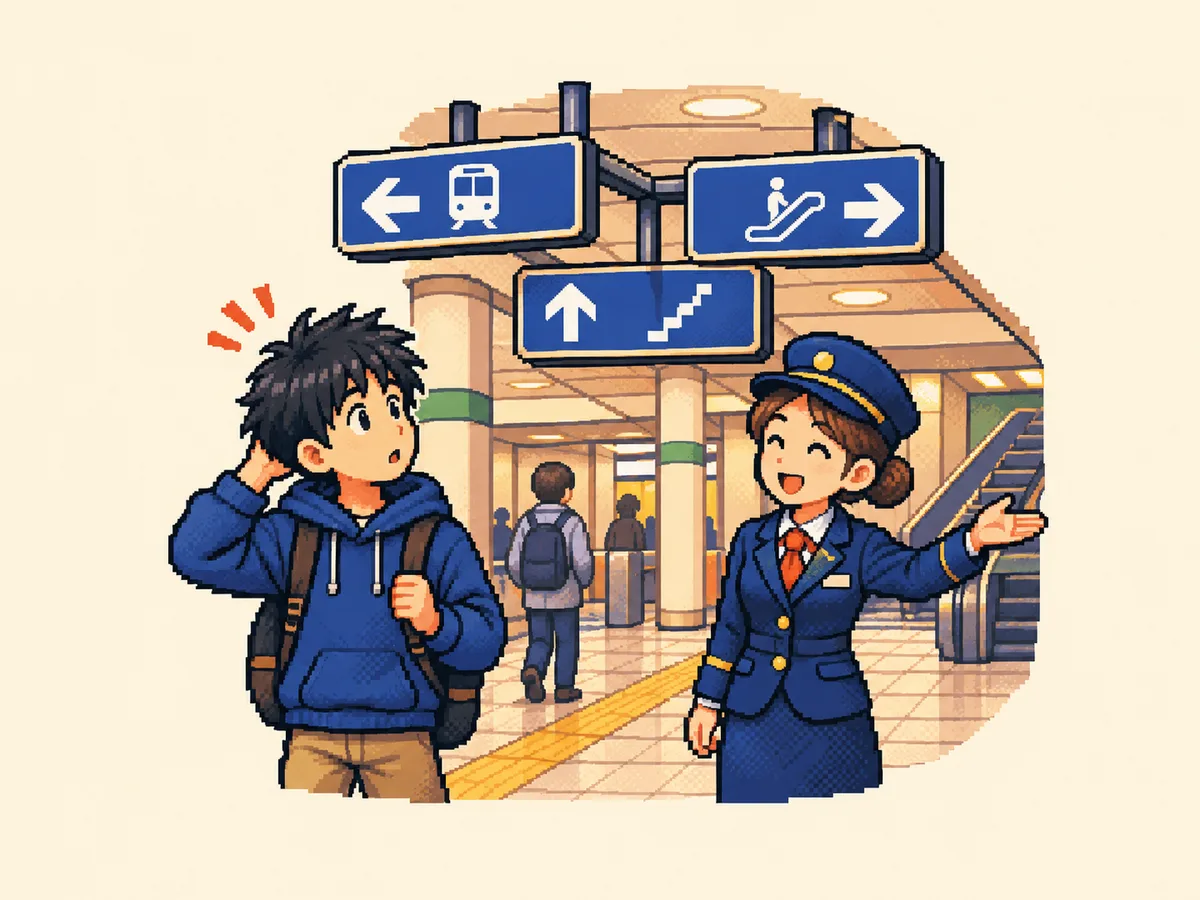
The first time I got lost in Shinjuku Station, I wasn't even outside yet. I had come up from the train platform, found the ticket gates, and walked out into a hallway with signs pointing in six directions. My hotel was a ten-minute walk away. I spent twenty-five minutes underground. Eventually I gave up, walked up to a station worker, and said the only full question I trusted myself with: 出口はどこですか。 (Deguchi wa doko desu ka.) Where is the exit?
She smiled, asked me something I didn't catch, and then pointed. Not at an exit. At a sign. It said 東口 (higashiguchi), and I realized there were at least four exits and I'd been asking the wrong question. I needed the east one.
That's what this lesson is about. One question pattern gets you to almost anywhere: the bathroom, the station, a convenience store, the police box. But asking is only half of it. The other half is understanding what comes back, which is usually a pointing hand and one word you need to recognize fast.
This is Part 1 of the Japanese for Travel series. If you've worked through the Food & Eating series, you already know は and を. If not, don't worry. This lesson starts from zero.
The one question you need: Xはどこですか
Here's the pattern:
[place] は どこ ですか。
- は (wa) marks the topic: "as for the station..."
- どこ (doko) means "where."
- ですか (desu ka) turns it into a polite question.
Put a place in the first slot and you're done.
駅はどこですか。 (Eki wa doko desu ka.) Where is the station?
トイレはどこですか。 (Toire wa doko desu ka.) Where is the bathroom?
Notice that は is written with the hiragana ha but pronounced wa when it's a particle. If that still trips you up, Common Mistakes to Avoid covers it.
Start with すみません
Walking up to a stranger and launching straight into a question feels abrupt in any language. In Japanese, you open with すみません (sumimasen) , which here means "excuse me."
すみません、駅はどこですか。 Excuse me, where is the station?
That's the whole move. I used it dozens of times on my first trip and never once needed anything fancier. 5 Common Japanese Phrases goes deeper on all the jobs すみません does.
Places travelers actually look for
These are the N5 words for the places you'll search for most. Every one of them slots straight into the question pattern.
| Japanese | Reading | Meaning | Notes |
|---|---|---|---|
| 駅 | eki | station | Train or subway |
| トイレ | toire | toilet, restroom | The everyday word |
| お手洗い | otearai | restroom | Politer; common on signs |
| 入口 | iriguchi | entrance | Literally "enter mouth" |
| 出口 | deguchi | exit | Literally "exit mouth" |
| コンビニ | konbini | convenience store | Not on the N5 list, but you'll use it daily |
| 交番 | kōban | police box | Small neighborhood police post |
| 銀行 | ginkō | bank | |
| 郵便局 | yūbinkyoku | post office | ATMs that take foreign cards |
| ホテル | hoteru | hotel | |
| エレベーター | erebētā | elevator | Handy with luggage |
| 階段 | kaidan | stairs |
Two of these deserve a closer look.
交番 is the most useful word on this list that nobody teaches tourists. A 交番 is a tiny police post, often on a street corner or right outside a station. The officers inside spend a lot of their day giving directions. They have detailed local maps and they know every building on their block. When I'm truly lost, I don't look for a station. I look for a 交番.
口 (kuchi, mouth) shows up in both 入口 and 出口, and it changes to guchi when it's attached to another word. That sound change matters in the next section.
ここ, そこ, あそこ: the answer you'll get
Here's the thing about asking where something is. Most of the time the answer isn't a sentence. It's one word and a point. And that word will be one of these:
| Japanese | Reading | Meaning | Where it is |
|---|---|---|---|
| ここ | koko | here | Near the speaker |
| そこ | soko | there | Near the listener |
| あそこ | asoko | over there | Away from both of you |
| どこ | doko | where | The question word |
English has two of these (here and there). Japanese has three, and the split isn't about distance in meters. It's about whose territory the thing is in.
- ここ is my space. If I'm standing next to the elevator, the elevator is ここ.
- そこ is your space. If the exit is right behind you, I'd say そこ.
- あそこ is neither of ours. The building across the street, the sign at the end of the hall.
So the most common answer you'll hear is simply:
あそこです。 (Asoko desu.) It's over there.
It will come with a hand gesture, so watch the hand. People in Japan usually point with an open palm, fingers together, rather than one finger. It's a little more polite, and it means you're looking for a flat hand sweeping toward something, not a jabbing finger.
The ko-so-a-do pattern
ここ, そこ, あそこ, どこ follow a pattern you'll see everywhere in Japanese. The first sound tells you the distance:
- ko- near me
- so- near you
- a- over there
- do- which one?
You already know this pattern if you've ordered food with これ (kore, this one). これ, それ, あれ, どれ are the "thing" version. ここ, そこ, あそこ, どこ are the "place" version. Learn the pattern once and you get both sets.
The polite version you'll hear from staff
Station staff, hotel clerks, and shop employees often use a politer set of the same words. They follow the same ko-so-a-do pattern:
| Casual | Polite | Reading | Meaning |
|---|---|---|---|
| ここ | こちら | kochira | here, this way |
| そこ | そちら | sochira | there, that way |
| あそこ | あちら | achira | over there, that way |
| どこ | どちら | dochira | where, which way |
You don't need to produce these. どこですか is perfectly polite when you're asking. But you need to recognize them, because こちらです (kochira desu) is what a hotel clerk says right before walking you somewhere. It means "this way," and it's your cue to follow.
If a taxi driver asks you どちらまで? (dochira made?), they want to know where you're headed. Just say the place and です: 駅です。
Station exits: 東口, 西口, 南口, 北口
This is the lesson I learned the hard way in Shinjuku. Big stations in Japan have several exits, and they're often named by compass direction. The direction words are all N5:
| Direction | Reading | Exit | Exit reading |
|---|---|---|---|
| 東 (east) | higashi | 東口 | higashiguchi |
| 西 (west) | nishi | 西口 | nishiguchi |
| 南 (south) | minami | 南口 | minamiguchi |
| 北 (north) | kita | 北口 | kitaguchi |
There's the 口 to ぐち sound change from earlier. Exits get the same treatment as 入口 and 出口.
The practical tip: before you get off the train, check your map app or hotel booking for which exit to use. Then ask for that one by name.
すみません、東口はどこですか。 Excuse me, where is the east exit?
That's a much better question than mine was. Asking for 出口 in a station with eight exits gets you a confused look, which is exactly what I got.
Many stations also number their exits, especially subway stations: A1, B3, and so on. Those signs use the same Roman letters and numbers you already read, so you can match them without any Japanese at all.
Understanding a slightly longer answer
Sometimes you'll get more than あそこです. The next most common answer tells you where something is relative to a landmark, using の (no) and a position word:
[landmark] の [position] です。
駅の前です。 (Eki no mae desu.) It's in front of the station.
You don't need to master this yet. Part 5 of this series covers directions properly. For now, learn to recognize these position words, because they're the ones that show up in answers:
| Japanese | Reading | Meaning |
|---|---|---|
| 前 | mae | in front of |
| 後ろ | ushiro | behind |
| 隣 | tonari | next to |
| 近く | chikaku | near, nearby |
| 中 | naka | inside |
| 向こう | mukō | across, on the other side |
So コンビニの隣です means "it's next to the convenience store," and 銀行の向こうです means "it's past the bank" or "across from the bank."
When they don't know
Sometimes the person you ask won't know either. You'll hear:
ちょっと分かりません。 (Chotto wakarimasen.) I'm not really sure.
ちょっと literally means "a little," but here it softens the "no." It's not a rejection. Say ありがとうございます and ask the next person, or look for a 交番.
A full exchange, start to finish
Here's what asking for directions looks like in a station, using only what's in this lesson.
| Speaker | Japanese | Meaning |
|---|---|---|
| You | すみません。 | Excuse me. |
| Staff | はい。 | Yes? |
| You | 西口はどこですか。 | Where is the west exit? |
| Staff | 西口は、あちらです。 | The west exit is that way. (open hand pointing) |
| You | あそこですか。 | Over there? |
| Staff | はい、エレベーターの隣です。 | Yes, next to the elevator. |
| You | ありがとうございます。 | Thank you. |
Notice the traveler says あそこ and the staff says あちら. Same meaning, different politeness level. That mix is completely normal.
Practice exercises
Tap each one to check. Say your answer out loud first.
Ask the question
Where is the bathroom?
トイレはどこですか。 (Toire wa doko desu ka.) お手洗いはどこですか。 is a politer option.Excuse me, where is the station?
すみません、駅はどこですか。 (Sumimasen, eki wa doko desu ka.)Where is the police box?
交番はどこですか。 (Kōban wa doko desu ka.)Where is the north exit?
北口はどこですか。 (Kitaguchi wa doko desu ka.) Remember 口 becomes guchi.
Pick the right word
The elevator is right next to you, the speaker. Which word?
ここ (koko). It's in your space.The exit is right behind the person you're talking to. Which word?
そこ (soko). It's in the listener's space.The bank is across the street, away from both of you. Which word?
あそこ (asoko).A hotel clerk says こちらです and starts walking. What should you do?
Follow them. こちらです means "this way."
Understand the answer
駅の前です。
It's in front of the station.コンビニの隣です。
It's next to the convenience store.ちょっと分かりません。
I'm not really sure. (They don't know.)
Spot the mistake
トイレをどこですか。 What's wrong?
The particle should be は, not を. を marks the object of an action like eating or ordering. Here トイレ is the topic: トイレはどこですか。出口ぐち (for "exit")
出口 is already deguchi. The 口 is the guchi. Don't add it twice.
Where to go from here
Now that you can find the station, Part 2 of this series takes you inside it: riding trains and subways, getting on and off, and changing lines. It's coming next week. In the meantime, if you want more practice with polite phrases like すみません and ありがとう, read 5 Common Japanese Phrases. And if katakana words like トイレ, ホテル, and エレベーター still slow you down, a few rounds of Hirakata katakana flashcards will fix that faster than you'd think.